Sunday, March 30, 2014

Philippines and Muslim rebel group sign peace deal

By OLIVER TEVES 
Associated Press
In this handout photo released by the Malacanang Photo Bureau, President Benigno S. Aquino III, back row secon from right, Malaysian Prime Minister Najib Razak, back row second from left, Moro Islamic Liberation Front (MILF) Chairman, Al Haj Murad Ebrahim, back row left, and Secretary Teresita Quintos-Deles, seated left, Presidential Adviser on the Peace Process, back row right, witness the signing of the Comprehensive Agreement on the Bangsamoro (CAB) by MILF chief negotiator Mohagher Iqbal, Datu Tengku Gnafar, seated center, and Miriam Coronel Ferrer, seated right, of the Philippine government in a ceremony at the Malacanang Presidential Palace in Manila, Philippines on Thursday March 27, 2014. The Philippine government signed a peace accord with the country's largest Muslim rebel group on Thursday, the culmination of years of negotiations and a significant political achievement for President Aquino.(AP Photo/Malacanang Photo Bureau, Benhur Arcayan) The Associated Press
In this handout photo released by the Malacanang Photo Bureau, President Benigno S. Aquino III, back row secon from right, Malaysian Prime Minister Najib Razak, back row second from left, Moro Islamic Liberation Front (MILF) Chairman, Al Haj Murad Ebrahim, back row left, and Secretary Teresita Quintos-Deles, seated left, Presidential Adviser on the Peace Process, back row right, witness the signing of the Comprehensive Agreement on the Bangsamoro (CAB) by MILF chief negotiator Mohagher Iqbal, Datu Tengku Gnafar, seated center, and Miriam Coronel Ferrer, seated right, of the Philippine government in a ceremony at the Malacanang Presidential Palace in Manila, Philippines on Thursday March 27, 2014. The Philippine government signed a peace accord with the country’s largest Muslim rebel group on Thursday, the culmination of years of negotiations and a significant political achievement for President Aquino.(AP Photo/Malacanang Photo Bureau, Benhur Arcayan) The Associated Press


MANILA, Philippines (AP) — The Philippine government signed a peace accord with the country’s largest Muslim rebel group on Thursday, the culmination of years of negotiations and a significant political achievement for President Benigno Aquino III.

The deal grants largely Muslim areas of the southern Mindanao region greater political autonomy in exchange for an end to armed rebellion. But it will not stop all violence in a part of the country long plagued by lawlessness, poverty and Islamist insurgency. Implementing the ambitious accord also will be challenging.

Aquino and leaders of the Moro Islamic Liberation Front witnessed the signing of the agreement in the presidential palace in Manila. Malaysian Prime Minister Najib Razak, whose country brokered the peace talks, attended the ceremony.

“In signing this agreement, the two sides have looked not to the problems of the past, but to the promise of the future,” Najib said. “After so many years of conflict, and so many lives lost, it is a momentous act of courage.”

About 1,000 people attended the signing ceremonies, including guerrilla commanders wearing business suits instead of military uniforms who were stepping into the palace for the first time.

“For generations, fellow Filipinos in the (southern Mindanao) region were embroiled in a cycle of poverty, injustice, and violence,” Aquino said. “If we are to truly address the root causes of conflict, we must close the gap between the region and the rest of Filipino society.”

Some in the crowd wiped away tears as presidential peace adviser Teresita Deles said in a speech, her own voice breaking: “No more war! … Enough!”

The peace accord concludes formal negotiations that began in 2001. A cease-fire agreement had been in place since 1997 and has been largely observed by both sides.

More than 120,000 people have died in separatist violence since the 1970s in Mindanao, the main southern Philippine island. It is home to most of the country’s 5 million Muslims, but Christians remain the overall majority.

Previous presidents, including Corazon Aquino, Aquino’s mother, tried but failed to resolve the conflict, which has stunted growth in the region and helped foster Islamic extremism in the country and elsewhere in Southeast Asia.

Other insurgent groups in the south have vowed to keep fighting for full independence. The region is also home to the Abu Sayyaf, a Muslim extremist network with international links that the Philippine army is battling with American support.

“I will not let peace be snatched from my people again,” Aquino said. “Not now, when we have already undertaken the most difficult and most significant steps to achieve it. Those who want to test the resolve of the state will be met with a firm response based on righteousness and justice.”

Under the accord, called the Comprehensive Agreement on the Bangsamoro, the Moro Islamic Liberation Front agreed to end violence and a demand for separate state in exchange for broader autonomy. An existing five-province Muslim autonomous region is to be replaced by a more powerful, better-funded and potentially larger region to be called Bangsamoro.

Bangsamoro is the term used by the rebels to refer to Muslims as well as other ethnic groups in the southern Philippines.

Rebel chairman Murad Ibrahim lauded the “shared victory of the Bangsamoro and the Filipino people.”

He said the agreement “finally brings with it the restoration of the identity, powers and resources of the Bangsamoro. These three things which have been ours since time immemorial unjustly taken through colonization and occupation are now returned to us.”

A 15-member commission comprising rebel and government appointees is to draft a law creating the new autonomous region.

The deal calls for rebel arms to be put “beyond use” by 2016, chief government negotiator Miriam Ferrer said. The decommissioning of rebel forces and weapons has already been flagged as a potential stumbling block in a region where even politicians have private armies and guns are easy to obtain.

U.S. and EU-funded conflict resolution groups have been backing the peace process. International monitoring groups have long been in the region and will continue to support the deal for years to come.

The Catholic Bishops Conference of the Philippines welcomed the agreement and urged the government and the Moro group to reach out to those “antagonistic” toward the peace deal.

“We pray that this first courageous breakthrough will be followed by more steps leading to true and lasting peace in Mindanao,” said Archbishop Socrates Villegas, the group’s president.

The national government and the new Moro government to be formed will have to counter four other armed Muslim groups, including a breakaway faction called the Bangsamoro Islamic Freedom Fighters.

Kristian Herbolzheimer, a director of Conciliation Resources, a conflict-resolution group, said even small numbers of fighters could potentially derail the accord.

“Success will depend very much on the performance of the peace process. If they are able to deliver something to the people to show that change is coming, I think that will be major deterrent against any threat,” he said.

A 1996 accord with the then main rebel group did not end the fighting because guerrilla fighters under its chairman, Nur Misuari, continued to hold on to their weapons. Misuari’s followers and government forces clashed in September 2013 in southern Zamboanga city, killing more than 200 people.

___

Associated Press writers Jim Gomez and Teresa Cerajano in Manila and Chris Brummitt in Hanoi, Vietnam, contributed to this report.

http://www.utsandiego.com/news/2014/Mar/27/philippines-and-muslim-rebel-group-sign-peace-deal/?#article-copy

Metro Manila is world’s second riskiest capital to live in–poll

By


INQUIRER FILE PHOTO

MANILA, Philippines— Lying smack in the middle of a fault-line and a typhoon path, Metro Manila is basically sitting on a ticking time bomb.

In a recent poll by Swiss Re, an international reinsurance company, Metro Manila is the world’s second riskiest ‘city’ in terms of natural disasters waiting to happen, behind only Tokyo-Yokohama in Japan.

The survey uses only the word “Manila”, which is just one of the cities in the Philippine capital. But citing the population of 34.6 million, the survey technically refers to Metro Manila.

Also called the National Capital Region, Metro Manila is composed of 15 cities and one municipality. They are the cities of Caloocan, Las Piñas, Makati, Malabon, Mandaluyong, Marikina, Muntinlupa, Navotas, Parañaque, Pasay, Pasig, Quezon, San Juan, Taguig and Valenzuela. Pateros is the only municipality. There are about 34.6 million residents as of 2013.

“Besides being exposed to frequent tropical cyclones and storm surges, many cities in the region are also located in zones of high seismic activity, including Tokyo, Taipei, and Manila,” Swiss Re said in a report.

Swiss Re based its findings on cities that are most susceptible to five natural disasters, earthquake, storm, storm surge, tsunami, and river flood.

According to Swiss Re, 34.6 million people are potentially on the receiving end of the five catastrophes.

“The vibrancy of these cities is a key driver for economic development,” Matthias Weber, Group Chief Underwriting Officer, said in the report. “However, the growing concentration of people, assets and infrastructure also means that the loss potential in urban areas is high and rising.”

Metro Manila, which has the Manila Bay on its west side, is very susceptible to flooding once the rainy season starts.

Rounding out the top ten riskiest cities were Tehran in Iran, Los Angeles in the United States, Shanghai River in China, Kolkata in India, Nagoya in Japan, Jakarta in Indonesia, Osaka-Kobe in Japan, and the Pearl River Delta in China.

Top five

In the crosshairs of the rankings, the region of Tokyo-Yokohama in Japan, Swiss Re said, is “by far the most earthquake exposed community” in the rankings with almost 30 million people potentially considered as victims.

It also tops the list in terms of the risk of a possible tsunami with 2.4 million people potentially affected.

As a region, the Pearl River Delta is comprised of the urban districts of Hong Kong, Shenzen, Dongguan, Macau, and Guangzhou, and is one of China’s main economic centers.

According to Swiss Re, the Pearl River Delta is highly susceptible to typhoon-related storm hazards, river and coastal flood zones and earthquakes.

Japan’s Osaka-Kobe region, according to the report, has 32.1 million people who are potential victims of the calamities and Jakarta has a potential of 27.7 million victims.

Osaka-Kobe, the report said, has a high risk of experiencing storm surges as its metropolitan areas were developed on large coastal plains.

In terms of the number of potential victims the rest of the rankings are Nagoya with 22.9 million, Kolkata with 17.9 million, Shanghai with 16.7 million, Los Angeles with 16.4, and Tehran with 15.6 million. 

Saturday, March 29, 2014

Muslim Mindanao is not Aceh

Rigoberto Tiglao
In her briefing Tuesday, Miriam Coronel-Ferrer, head of the government’s panel in the talks with the Moro Islamic Liberation Front, said:

“The signing of the “comprehensive agreement” is also our global contribution to the pursuit of peace in our immediate neighborhood, the Southeast Asia region, and the rest of the world. The last momentous agreement of this kind was those sealed in Aceh, Indonesia between the Republic of Indonesia and the Free Aceh Movement in 2005.”

It was a slip of the tongue that confirms what I had been told since the so-called “Framework Agreement on the Bangsamoro” was signed October 2012.

President Aquino, his peace-talks adviser Teresita Deles, and Ferrer— and the Muslim insurgent organization’s leaders — are patterning their hoped-for peace pact after that of Indonesia in 2005 with the Free Aceh Movement (known as Gerakan Aceh Merdeka, or GAM, whose official name is the Aceh-Sumatra National Liberation Front).

The GAM fought for the independence of Aceh from 1976, in which 30,000 lives were lost until it entered into peace agreement with the Indonesian government in 2005, brokered by the government of Finland.

It did usher in peace in Aceh. I don’t think though Filipinos would like the system in Aceh now, which became more Islamic than elsewhere in Indonesia, which is already the biggest Islamic nation on earth.


A tale of two Muslim insurgencies: (Right), the Free Aceh Movement in Indonesia; the MILF—or “Free Moro”—fighters.

If Aquino and his negotiators think the Aceh agreement is such a good thing, for it to be their template, they’ve got to have a reality check, rather than keep dreaming of winning the Nobel prize. (Indeed the aim of Aquino’s rush to meet the MILF leaders in Tokyo in August 2011, as I had written and which explains why so much was committed to the MILF, was to meet the February deadline for nominations for the Nobel awards in February 2012. Strangely or purposively, the government press release on Ferrer’s appointment as chief negotiator in December 2012 pointed out: “She was also one of 27 Filipinos nominated to receive the Nobel Peace Prize in 2005.” However, Nobel nominations are kept secret.)

For starters, consider the international newsmagzine The Economist’s article Feb. 14, 2014 on Aceh titled “Laying down god’s law.” The article read: “The (Aceh) provincial parliament passed laws against drinking, gambling and ‘seclusion’—being alone with someone from the other sex. An Islamic police force modeled on Iran’s “vice and virtue” patrols started to round up women for not covering their heads or for wearing trousers that were too tight. The first public caning took place in 2005.”

That won’t happen in Muslim Mindanao, as it didn’t in the Autonomous Region for Muslim Mindanao?

Shari’ah justice

Check again Aquino’s “Framework Agreement on the Bangsamoro” agreed with the MILF, specifically Part III (“Powers”), paragraph 4:

“The Parties recognize the need to strengthen the Shari’ah courts and to expand their jurisdiction over cases. The Bangsamoro shall have competence over the Shari’ah justice system.”

But what is more worrying is that Aquino has taken as his template the Aceh agreement, when the political structure and history of both Aceh and Indonesia are totally different from ours.

First, the Indonesian government had launched a full-scale war against GAM from 2002 to 2004, which halved the insurgent’s forces with its head even killed in a battle with the Indonesian army.

The GAM was also so severely hit by the December 2004 tsunami that it declared a unilateral ceasefire. Because of alleged atrocities and human rights abuses by the Indonesian military, and because of the widespread publicity of the devastation by the tsunami, foreign governments put pressure on Indonesia to enter into peace talks with GAM. In short, the GAM entered the peace talks in a condition of weakness, unlike the MILF now.

Second, and most important, Aceh even before the 2005 peace agreement was among the four provinces of Indonesia (the other three being Jakarta, Yogyakarta, Papua, and West Papua) that had a high degree of autonomy, with their own powerful legislative bodies.

The peace agreement merely expanded the autonomy of Aceh to near independent status.

The core of the Aceh pact actually was the Indonesian government’s commitment to pass a law expanding the province’s power, and even promising a March 2006 deadline for that commitment, or just seven months after the pact was signed.

In sharp contrast, the agreement with the MILF requires not just a law, which is also necessary, but amending our Constitution. This is because the pact’s crucial provisions violate the Constitution.

Among these agreements that do not comply with the Constitution are (1) for the MILF to have its own police force, (2) for the “Bangsamoro” (which in Bahasa means “Moro nation”) to have a parliamentary form of government, and (3) for that essentially Islamic state to get 75 percent of the revenues from national taxes and from those generated through natural-resources extraction.

This point in fact makes the much-hyped ceremony yesterday for the signing of the agreement an utter farce. What agreement?

No consultations

The agreement is an agreement only between the MILF and Aquino together with Deles and Ferrer.

Even Aquino’s Cabinet, much less Congress, which Aquino still controls, had absolutely no role in crafting the “Framework Agreement with the Bangsamoro” and its annexes. Aquino’s small circle dealing with the MILF did not even consult with Congress for the pact even if the lawmakers will play the most crucial role in making it a real pact, by enacting a law that would implement its provisions and call for amending the Constitution.

The requirement for such consultations was in effect one of the two major grounds the Supreme Court cited when it ruled unconstitutional in 2008 the so-called “Memorandum of Agreement on Ancestral Domains” former President Arroyo’s negotiators agreed with the MILF.

The Court’s words in that ruling applies exactly to the Aquino government’s pact with the MILF:

“The Presidential Adviser on the Peace Process committed grave abuse of discretion when he failed to carry out the pertinent consultation process, as mandated by E.O. No. 3, Republic Act No. 7160, and Republic Act No. 8371. The furtive process by which the agreement was designed and crafted runs contrary to and in excess of the legal authority, and amounts to a whimsical, capricious, oppressive, arbitrary and despotic exercise thereof. It illustrates a gross evasion of positive duty and a virtual refusal to perform the duty enjoined.”

Furtive certainly has been the Aquino’s talks with the MILF. First, the crucial details — such as on power sharing and demobilization –were referred to only as “Annexes” in the Framework Agreement. Then the negotiators would suddenly just announce that these “Annexes” had been agreed upon with the MILF, after a period of closeting themselves with the insurgents.

It is actually astonishing why Aquino’s negotiators seem oblivious to the constitutional principles laid down in the Supreme Court’s decision on the MOA-AD case, as if simply because it is Aquino who is sponsoring the new pact with the MILF makes it constitutional.

The panel’s disregard of the MOA-AD precedent also reflects one of its main fatal weaknesses: None of the negotiators are lawyers, reflecting their utter ignorance that other than good-will, it is the legalities that are crucial in any agreement between two parties, whether it is for peace or the purchase of a house.

Aquino’s negotiators, I would bet, didn’t even bother to read the Court’s decision on the MOA-AD issue. If they did, they would have known the most important reason why it was ruled unconstitutional, which would make their agreements with the MILF a waste of time and money.

Senior justice Antonio Carpio in his concurring opinion in that ruling best summarized this reason, which so precisely applies to Aquino’s pact:

Unconstitutional

“The agreement between the Government of the Republic of the Philippines and the MILF is patently unconstitutional. The Executive branch’s commitment under the agreement to amend the Constitution to conform to it violates Sections 1 and 4, Article XVII of the Constitution. The Executive branch usurps the sole discretionary power of Congress to propose amendments to the Constitution as well as the exclusive power of the sovereign people to approve or disapprove such proposed amendments.”

The Court’s decision in fact was written by Aquino’s favorite justice then, Conchita Carpio-Morales, now the Ombudsman:

“(The agreement) virtually guarantees that the necessary amendments to the Constitution and the laws will eventually be put in place. Neither the GRP Peace Panel nor the President herself is authorized to make such a guarantee.

“Upholding such an act would amount to authorizing a usurpation of the constituent powers vested only in Congress, a Constitutional Convention, or the people themselves through the process of initiative, for the only way that the Executive can ensure the outcome of the amendment process is through an undue influence or interference with that process….

“(The) act of guaranteeing amendments is, by itself, already a constitutional violation that renders the agreement fatally defective.”

Three petitions in fact have been filed with the Supreme Court questioning the legality of Aquino’s pact with the MILF.

I don’t think the Court will agree to be Aquino’s puppet and ignore the constitutional principles it laid down in the case of the MOA-AD agreement. This is especially so since the President had sent a message that he doesn’t care what the Supreme Court decides by having a grandiose event the other day celebrating the agreement with the MILF, even witnessed by foreign governments’ representatives, even if there is a very serious constitutional challenge against it.

Plagiarists — whether in writing or in politics — always make poor copies of the original. The Indonesian government’ pact with the Free Aceh Movement (GAM) had the following provision, which I quote verbatim, in its August 2005 “Memorandum of Understanding between the Government of the Republic of Indonesia and the Free Aceh Movement”:

“GAM undertakes the decommissioning of all arms, ammunition and explosives held by the participants in GAM activities with the assistance of the Aceh Monitoring Mission. GAM commits to hand over 840 arms.

The decommissioning of GAM armaments will begin on 15 September 2005 and will be executed in four stages and concluded by 31 December 2005.”

There is no such specific commitment from the MILF in Aquino’s agreement with them. The MILF has not committed to hand over a single rifle or even pistol. Section C, paragraph 9 of the “Annex on Normalization” merely says:

“The decommissioning of MILF forces shall be parallel and commensurate to the implementation of all the agreements of the Parties.”

What a poor, poor copy of the Aceh peace pact.

(On Monday, my promised piece on how SEC and PLDT defied the Supreme Court.)
tiglao.manilatimes@gmail.com
www.trigger.ph and www.rigobertotiglao.com

Key points on Philippine Muslim peace pact, rebels


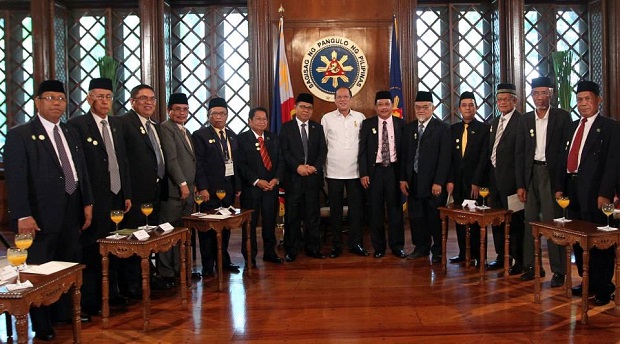
President Benigno S. Aquino III huddles with Moro Islamic Liberation Front (MILF), led by its chairman Al Haj Murad Ebrahim, for a group photo souvenir during the Courtesy Call at the President’s Hall of the Malacañan Palace on Thursday, March 27, 2014. Photo by Ryan Lim/Malacañang Photo Bureau


MANILA – The Moro Islamic Liberation Front (MILF) ended four decades of armed struggle in the Philippines on Thursday when it signed a peace pact with the government.

Here are key facts on the MILF and the peace deal:

MILF: The MILF has about 10,000 armed followers, according to the military, which makes it easily the biggest Muslim rebel group in the Philippines.

It has long fought for an independent homeland for the nation’s Muslim minority to be carved out of the southern Philippines.

It split in the 1970s from the-then main rebel group, the Moro National Liberation Front (MNLF). The MNLF had agreed to autonomy, and founding MILF leader Hashim Salamat was intent on fighting for independence. Internal rivalries were another reason for the split.

PEACE PACT:

TITLE: Called the “Comprehensive Agreement on the Bangsamoro.” The Bangsamoro refers to people who at the time of Spanish conquest and colonisation were considered natives or original inhabitants of the southern Philippines. Their descendants and spouses are recognized as Bangsamoro people.

Bangsa is a local word for nation. Moro derives from the term “Moors” used by Spanish colonialists to refer to Muslims.

AUTONOMY: The MILF drops its claims for a separate state in the southern region of Mindanao and settles for parliamentary self-rule in the Bangsamoro autonomous region. This will be established by 2016. The Bangsamoro will replace another Muslim autonomous region that was brokered in the 1990s with the MNLF, which the government says has failed.

DISARMAMENT: The MILF will “gradually” decommission its forces and put the weapons “beyond use.” A local police force will assume law enforcement functions from the Philippine police and military.

POWERS: The Philippine government will retain exclusive powers on defence, foreign policy, currency and citizenship matters.

TAXES/REVENUES: The autonomous government will receive 75 percent of all local taxes, fees and charges, 75 percent of revenues from metallic minerals and control of fishing areas up to 12 nautical miles from the coastline.

ISLAMIC LAW: The region will not be an Islamic state, rather a secular government. Sharia law will apply only to Muslims and only for civil cases, not for criminal offences. All residents are guaranteed basic rights to life, movement, privacy, and freedom of religion and speech.

TERRITORY: To cover five provinces, plus two cities, six towns and 39 villages in the south, comprising about 10 percent of the Philippines’ total land area.

ENABLING LAW: Philippine President Benigno Aquino will seek to steer through parliament a “Bangsamoro Basic Law” for the autonomous region by the end of this year.

PLEBISCITE: People living in areas to be included in the autonomous region will need to ratify the law in a plebiscite to be held in 2015.

TRANSITIONAL AUTHORITY: After the basic law is approved and ratified by the plebiscite, a 15-member “Bangsamoro Transition Authority” will govern the region until a regional parliament is elected. Aquino appoints the members of the transitional authority, but the MILF will have a majority and the chairman.

ELECTIONS: A regional parliament, expected to have 50 seats, is to be elected in conjunction with national elections in May 2016.


US Navy to deploy first laser armed warship this summer

By Art Villasanta
Ecumenical News 
 USS Ponce, an Austin-class amphibious transport dock of the United States Navy. (Photo: United States Navy)
USS Ponce, an Austin-class amphibious transport dock of the United States Navy. (Photo: United States Navy)
The science fiction ray gun firing a beam of destructive light will become a real world threat this summer. The United States Navy has deployed a prototype Laser Weapon System, or LaWS, aboard the USS Ponce for sea trials that could last about a year. LaWS is the first laser weapon system mounted on a warship by any country.
Once accepted into service between 2017 and 2021, the solid-state LaWS will allow the Navy to effectively neutralize aerial drones, swarm boats and other threats by destroying or crippling them with an intense beam of laser heat that melts internal circuitry and machinery. LaWS is presently not designed to engage incoming missiles, large aircraft, ships or submarines but this capability can be built-in at a later date.
Laser Weapon System
Laser Weapon System
The Navy spent about $40 million over the past six years on research, development and testing LaWS. In operation, the weapon can be aimed accurately at targets by the ship’s Phalanx CIWS radar. LaWS has an effective range of one mile or 1.6 kilometers.
LaWS, which is a directed-energy weapon, is finding favor within the US armed forces because its “ammunition” is cheaper than conventional explosive rounds. It laser light beams can be fired for as little as one dollar per shot, while conventional rounds and missiles cost thousands of dollars each.
LaWS uses a solid-state infrared beam that can be tuned to high output to destroy a target or low output to warn or cripple the sensors of a target. Its power output is estimated between 15kW to 50kW for engaging small aircraft and high-speed boats.

COA unearths new P515-M ‘pork’ scam

By Jess Diaz 
The Philippine Star 
Commission-on-AuditMANILA, Philippines – The Commission on Audit (COA) has unearthed a new pork barrel scam, this time involving nearly P515 million coursed through an agency under the Office of the President.
This was the first time that irregularities in the use of congressional funds had reached the doorsteps of Malacañang under the administration of President Aquino.
The agency involved is the National Commission on Muslim Filipinos (NCMF), headed by former elections commissioner Mehol Sadain.
Two senators – Juan Ponce Enrile and Gregorio Honasan – and 38 former and incumbent members of the House of Representatives allocated more than P514 million to NCMF in 2012.
According to the newest COA report, copies of which have been sent to the House, the funds ended up in 18 foundations and non-government organizations (NGOs), some of which are identified with alleged pork barrel scam brains Janet Lim-Napoles.
The NGOs supposedly used the money for various livelihood projects, training and seminars for Muslim Filipinos.
“The audit team was informed that the concerned lawmakers were the ones who identified the NGOs/POs (people’s organizations), and not NCMF, as evidenced by the letters of the lawmakers to the secretary of the NCMF,” the report said.
The report classifies P25 million of the releases as coming from Malacañang’s controversial Disbursement Acceleration Program (DAP), while the rest came from the now unconstitutional Priority Development Assistance Fund (PDAF) – the congressional pork barrel’s official name.
“It is our view that the selection of NGOs/POs should be undertaken by NCMF because the funds were released to NCMF, and therefore, the same agency is duty-bound to account for the funds to the government and/or beneficiaries,” the audit team said.
“The practice of allowing lawmakers to select NGOs/POs to implement the PDAF and DAP was not in accordance with COA Circular No. 2007-001. The selection should not be done by lawmakers but by NCMF officials having full responsibility over the funds released to them,” it said.
The circular governs the release of government funds to NGOs. It provides guidelines on the use of such funds.
The audit team noted that the memoranda of agreement (MOA) signed by NCMF, the lawmakers and their chosen NGOs lacked certain requirements prescribed in the circular, such as “time schedules for the releases of funds, periodic inspection/evaluation, reporting, monitoring, date of commencement (of projects), and date of completion.”
It said many of the fund releases lacked supporting documents like contracts and purchase orders.
18 foundations
The COA report lists the 18 foundations, the lawmakers who gave them funds and the amounts released to these NGOs. Many of the fund givers were party-list representatives.
Honasan gave P30 million to Focus on Development Goals Foundation Inc. for projects for Muslim Filipinos in Taguig, Manila, Quezon City, Valenzuela, Caloocan, and Navotas.
Enrile allocated P25 million to Livedures Foundation, while Rep. Maximo Rodriguez of party-list group Abante Mindanao gave it P12 million.
The biggest NGO-recipient was Kaagapay Magpakailanman Foundation, which cornered P160 million of the lawmakers’ P515-million allocations.
Kaagapay received P11 million from Representatives Nelson Collantes (Batangas), P4.5 million from Homer Mercado (1-UTAK), P20 million from Michael Angelo Rivera (1-CARE), P10 million from Jose Benjamin Benaldo (Cagayan de Oro City), P5 million from Justice Marc Chipeco (Calamba City), P9 million from Jonathan Yambao (Zamboanga Sibugay), P10 million from Angelo Palmones (Agham);
P15 million from Nur Ana Sahidullah (Sulu), P3 million from Isidro Lico (Ating Koop), P5 million from Neil Benedict Montejo (An Waray), P6 million from Erico Basilo Fabian (Zamboanga City), P7 million from Nicanor Briones (AGAP), P13.8 million from Yevgeny Vicente Emano (Misamis Oriental), P7.8 million from Daryl Grace Abayon (Aangat Tayo), P14 million from Raymond Democrito Mendoza (TUCP), P15 million from Antonio Kho (Senior Citizens), and P5 million from Mariano Piamonte (A Teacher).
Maharlikang Lipi Foundation Inc. was the second biggest recipient with P67.7 million.
The funds came from Lorenzo Tañada III (Quezon), P10 million; Salvador Cabaluna III (1-CARE), P15 million; Maria Isabel Climaco (Zamboanga City), P11 million; Sharon Garin (AAMBIS-OWA), P5 million; Ponciano Payuyo (APEC), P2 million; Hajiman Hataman-Salliman (Basilan), P11.5 million; Simeon Datumanong (Maguindanao), P3.8 million; and Cesar Jalosjos (Zamboanga del Norte), P9.4 million.
Kapuso’t Kapamilya Foundation received P37 million from Abayon (AAMBIS-OWA), P7.5 million from Cabaluna, P7.5 million from Rivera, P2 million from Franklin Bautista (Davao del Sur), P10 million from Fatima Aliah Dimaporo (Lanao del Norte), P5 million from Briones, and P5 million from Sahidullah, for a total of P64 million.
Some P62 million was released to Rich Islas de Filipinas Foundation Inc.
The fund givers were Tañada, P10 million; Arnulfo Go (Sultan Kudarat), P15 million; Romeo Jalosjos Jr. (Zamboanga Sibugay), P5 million; Cabaluna, P15 million; Salliman, P12 million; and Yambao, P5 million.
Some P25.170 million was made available to Kagandahan ng Kapaligiran Foundation.
The funds came from Dimaporo, P15 million; Piamonte, P5 million; Bernardo Vergara (Baguio City), P3.670 million; and Teodorico Haresco (Ang Kasangga), P1.5 million.
Kabalikat sa Kalusugan Foundation received P4 million from Climaco and P6 million from Collantes, while I-Help Foundation received P7 million from Fabian.
Rosendo Labadlabad (Zamboanga del Norte) allocated P3 million to Kaisa’t Kaagapay Mo Foundation, while Arturo Robes of San Jose del Monte City in Bulacan gave P1 million to Workphil Foundation.
Kaakbay-buhay Foundation received P3.5 million from Rodriguez, while Mark Aeron Sambar (PBA) gave P5 million to Pangkabuhayan Foundation.
Some P14 million was released to Coprahan at Gulayan Inc. – P10 million from Ranulfo Canonigo (KAKUSA) and P4 million from Bai Sandra Sema (Maguindanao).
Additionally, Fabian of Zamboanga City gave P11 million to BL Personal Touch Foundation, while Salliman gave P1.1 million to UF Multi-purpose Corp.
Anthony Golez of Bacolod City allocated P10 million to Kabuhayan at Kalusugan Alay sa Masa Foundation.
The release of the NCMF audit report followed the posting on the COA website of the audit findings on more than P100 million in pork barrel funds given by almost the same lawmakers to the same foundations through Philippine Forest Corp. (Philforest), also in 2012.
In the case of Philforest, eight foundations were used as fund conduits, including seven that figured prominently in the NCMF report.
The seven are Focus on Development Goals Foundation, Kaagapay Magpakailanman Foundation, Kapuso’t Kapamilya Foundation, Livedures Foundation, Maharlikang Lipi Foundation, Pangkabuhayan Foundation, and Workphil Foundation. The eighth Philforest conduit was Interactive Training Opportunity on Needs Alleviations Movement Inc. (ITONAMI).
Honasan, Sen. Lito Lapid and 19 House members were the sources of the P100.170 million given to these eight NGOs through Philforest.
The audit findings on NCMF and Philforest are contained in annual audit reports.
Show your rage
With some of the country’s most prominent politicians now being dragged into the PDAF scam issue, Sen. Miriam Defensor-Santiago called on the youth not to vote for them and to show them their anger through social media.
“Be angry at these politicians who stole the taxes you and your parents pay. When you reach the voting age, which is 18, do not vote for them. Instead, shame them now,” Santiago said in her speech at the Rogationist College in Silang, Cavite yesterday.
“The pork barrel scam, for example, concerns you. When you buy something, eat at a restaurant, or use public transportation, you pay taxes. These taxes should have been used to fund fast trains coming here to Cavite, to lessen travel time and expense,” she said.
“By now, we should also have had better hospital facilities in all cities and provinces. If you get sick, these taxes should be used to fund your hospital care,” she said.
Implicated in the PDAF scam are Enrile and Senators Jinggoy Estrada and Ramon Revilla Jr.
“Take your campaign to Facebook, Twitter or Tumblr. Post your grievances on these politicians’ walls. Tweet them your disappointments. Eventually, these politicians will shed their thick hides because of the shame, and reveal themselves to be spineless pathetic creatures,” she added.
“A nation is only as strong as its people. Do not subscribe to the bahala na (come what may) attitude and allow things to go with the flow. For evil to triumph, it is enough for good men to do nothing,” she said.
Santiago is among the most popular politicians among the youth, judging from the huge number of her followers on Facebook and Twitter. Her staff said she has 1.3 million Facebook fans, making her the most followed on Facebook among her colleagues.
Sen. Francis Escudero has the second biggest number of Facebook fans with 463,699, followed by Alan Peter Cayetano, Loren Legarda, Enrile, Grace Poe, Aquilino Pimentel III, JV Ejercito, Pia Cayetano, Cynthia Villar, Ferdinand Marcos Jr., Teofisto Guingona III, Gregorio Honasan and Nancy Binay.
On Twitter, Santiago’s office noted she also has the most number of followers at 649,000. Escudero is also at second place with 176,118 followers, followed by Marcos, Legarda, Juan Edgardo Angara, Ejercito, Enrile, Guingona, Paolo Benigno Aquino IV, Pimentel, Poe, Antonio Trillanes IV, Honasan, Binay, Villar, Revilla and Senate President Franklin Drilon. Santiago’s office noted that Lapid does not have an official Twitter account. – With Marvin Sy

Putin’s Potemkin Economy

There are few sources of income other than oil and gas, and wealthy Russians are moving $60 billion a year out of the country.

By Ruchir Sharma
The Wall Street Journal
A Gazprom gas station near the headquarters of Gazprom in Moscow. Bloomberg News
Vladimir Putin had been named the “world’s most powerful person” last year by Forbes magazine well before he annexed Crimea. The land grab added to the string of geopolitical victories credited to the Russian leader—including his rescue of Syria’s Bashar Assad in the chemical-weapons standoff and the safe harbor he gave to the American secrets-spiller Edward Snowden. But Mr. Putin’s real power base, the economy, is crumbling.
Russia’s economic growth rate has plummeted from the 7% average annual pace of the last decade to 1.3% last year. Now the brokerage arm of the country’s largest state bank, Sberbank, expects zero growth in 2014.
Sensing trouble, wealthy Russians have been moving money out of the country at one of the fastest rates in two decades—$60 billion a year since 2012—and now foreign investors are pulling out too. The ruble has fallen by 22% against the U.S. dollar since 2011, and the Central Bank of the Russian Federation has been fighting to prevent a ruble collapse since the Crimean crisis began.
The situation is especially revealing because oil—the mainstay of the Russian state—has stayed relatively stable, hovering at $110 per barrel for three years. Yet the Russian economy is stagnating. This suggests deep-seated problems.
After Mr. Putin became president in 2000, he began working to end the political turmoil and inflation that gripped Russia under Boris Yeltsin. He managed the economy responsibly, getting control of the government budget and retiring debts. Rising global oil prices and easy money did the rest. Between 2000 and 2010, growth and per capita income rose to $10,000 from $1,500. Mr. Putin started this decade with an approval rating of 70%.
But he grew complacent and cocky. Former KGB allies replaced economic reformers in his inner circle. As former President George W. Bush told me in an interview, Mr. Putin in private conversations morphed from a leader who worried about Russia’s debt to one who by 2008 taunted the U.S. for having too much debt. He went from saving oil profits in a rainy-day fund to spending them to cement his power.
Before 2008, Russia was putting back to work the oil fields, factories and labor force that were idled by the collapse of the Soviet Union. Even so, Mr. Putin built little that was new. While Russia has a relatively high rate of investment, 26% of GDP, much of the money gets funneled into dubious projects by the state. Now the spare capacity is shrinking, and the old Soviet roads and railways are deteriorating, as any regular visitors to Russia can attest.
The inflation rate now stands at 6.3%, fourth highest among the major emerging markets, and well above the emerging world average of 3.8%. Russia has become a classic weak-investment, high-inflation economy.
Despite his growing reputation as a geostrategic mastermind, Mr. Putin’s economic strategy is increasingly self-defeating, focused on extending Kremlin control. While countries like Mexico are moving to open up the state oil industry, Russia is closing it off, tossing out foreign partners. Rosneft, the large state oil company, is buying out private companies and now controls 40% of the country’s oil production. It is launching its own oil field-services company, bringing in-house a service that multinational oil companies have been hiring out to efficient private contractors for years.
Russia grew richer during the last decade but did not develop in the normal sense of building up more sophisticated manufacturing industries. In a vibrant developing economy such as Korea or the Czech Republic, manufacturing accounts for at least 20% of GDP. Manufacturing in Russia accounts for just 15% of GDP, down from 18% in 2005. Small and medium-size companies of any kind, including banks, struggle to gain a foothold alongside state behemoths.
The result is that the Russian state has few new sources of income outside of oil and gas, at a time when it is taking on more dependents. Demographics are putting a squeeze on public finances, as roughly a million Russians are retiring each year, and too few young people are replacing them in a workforce of about 100 million. The situation leaves fewer taxpayers to fund pensions, after a five-year period in which the Kremlin raised pension payouts by an average of 25% a year.
This is a medium-term threat to the federal budget, which is in surplus now but shows a dangerous deficit if oil revenues—$222 billion or around 10% of GDP last year, according to IMF figures—are left out of the equation. Because of slowing growth and deteriorating terms of trade, the non-oil government deficit is now 11% of GDP. The current account is in a similar position: an apparent surplus, dependent on oil. The non-oil current-account deficit is currently running at a whopping 10% of GDP.
To keep its federal budget in balance, Russia requires an oil price of $110 barrel, so it is tiptoeing on the edge. Yet because other commodity prices have fallen, the price of oil, now $107 per barrel, is at a 30-year high compared with industrial metals. This suggests that oil, too, may be poised for a downshift—which would have a crippling impact on the Russian economy.
For now Russians are applauding their president’s confident portrayal of the great power player. But that may change if the economy keeps deteriorating. Remember that by late 2011, as the scale of Russia’s slowdown was becoming clear, Mr. Putin’s approval ratings tanked and he faced protests in Moscow.
Mr. Putin’s approval rating has bounced back following the Sochi Olympics and the invasion of Crimea. But the rest of the world should not be fooled. The world’s “most powerful man” is scoring his geopolitical victories from an increasingly vulnerable economic position.
Mr. Sharma is head of emerging markets at Morgan Stanley Investment Management and author of “Breakout Nations: In Pursuit of the Next Economic Miracles” (Norton, 2012).
Copyright 2013 Dow Jones & Company, Inc. All Rights Reserved
This copy is for your personal, non-commercial use only. Distribution and use of this material are governed by our Subscriber Agreement and by copyright law. For non-personal use or to order multiple copies, please contact Dow Jones Reprints at 1-800-843-0008 or visit