Wednesday, April 2, 2014

‘CAB puts peace in jeopardy’

by JERRY ADLAW
CORRESPONDENT
In this file photo, MNLF leader Nur Misuari addresses armed followers at their camp in Indanan, Sulu.

General Santos City: President Benigno Aquino 3rd has derailed the peace process in the southern Philippines by sacrificing another Muslim group when he signed the Comprehensive Agreement on the Bangsamoro (CAB) with the Moro Islamic Liberation Front (MILF), the leader of the International Police Commission (IPC) said on Sunday.

Malacanang apparently was unperturbed by the accusation, with Herminio Coloma, chief of the Presidential Communications Operations Office, saying: “All stakeholders are called upon to participate in the peace and rebuilding process.”

Gen. Rafael Clarete, president of the IPC, which is recognized by the United Nations Economic and Social Council, said the President, as a result of inking the CAB last week, now risks “serious uprising and secession” from the Moro National Liberation Front (MNLF).

Clarete, speaking from General Santos City in Mindanao after arriving from California also last week, added that Malacanang should have honored the peace agreement that the government signed with the MNLF on September 2, 1996 before “expediting” the CAB.

The President would have no one to blame but himself “if war erupted between the MNLF and the government,” he warned.

Clarete said Aquino, in signing the peace agreement with the MILF, leaves his successor the “burden of a war” that would fester for years.

The IPC president, who met with senior MNLF leaders in Mindanao last Monday, learned that the President had put aside ironing out 42 supposedly defective provisions of Republic Act 9054 and other clauses under Phase I and Phase II of the 1996 peace agreement in favor of signing the CAB.

“How can you have peace in the region [Mindanao] when a large force [MNLF] is [girding] for war… that would erupt soon because the Aquino government cannot totally implement the provisions of the 1996 peace accord?” Clarete said.

The IPC leader, who flew to the Philippines to observe the signing of the CAB, said he will make a critical report to the US government that would mention the supposed discontent of the MNLF under the Aquino administration.

The President trusted the MILF too much when the group’s leaders are “not capable of handling” the Bangsamoro homeland, according to Johnny Siao, chief of the MNLF’s National Border Command forces based in Mindanao.

Henry Dazo, a retired police superintendent, agreed, saying the MILF leadership lacks “experience and leadership.”

A newly created group called Southern Philippines Tri-People Indigenous Association, which is said to be composed of 10,000 members, also on Sunday said it was supporting the MNLF’s demand that the government fulfill first the terms of the 1996 peace agreement before implementing the peace deal with the MILF.

Hotbed of insurgency
Still, Mindanao will remain a hotbed of insurgency even if CAB is implemented immediately, according to the Armed Forces of the Philippines.

This is attributed by the military to the presence of the communist New People’s Army (NPA), the Bangsamoro Islamic Freedom Fighters, the terrorist Abu Sayyaf Group and other threat groups.

Maj. Gen. Ricardo Visaya also on Sunday disclosed that one-half of the total strength of the NPA, the armed wing of the Communist Party of the Philippines (CPP), is concentrated in Mindanao.

The NPA, he said, is “strongest” in areas under the 4th Infantry Division and the 10th ID.

The 4th ID spokesman, Capt. Christian Uy, said their division has jurisdiction over the Northern Mindanao area, which includes the Caraga region, composed of the provinces of Agusan del Sur and Agusan del Norte, Dinagat Islands, Surigao City and Butuan City.

Also under the 4th ID are Misamis Oriental, Bukidnon and Camiguin in Region 10 with the cities of Cagayan de Oro, Gingoog, Malaybalay and Valencia.

First Lt. Ernesto Carolina, 10th ID spokesman, said under their area of responsibility are the southernmost parts of Agusan del Sur and Bukidnon, Compostela Valley, Sarangani, Davao del Norte, Davao del Sur, Davao Oriental and the easternmost part of North Cotabato.

Madlos is one of the most senior communist leaders and one of the top contenders to replace Benito Tiamzon, allegedly the CPP chairman, who was recently arrested with his wife Wilma.

Armed Forces chief Gen. Emmanuel Bautista said the NPA is almost a spent force and would be “irrelevant” by 2016.

The military has claimed that 25 out of 81 provinces in the country are insurgency-free and that the NPA’s strength has dwindled to 4,043 from a peak of 24,430 fighters during the 1980s.

A lawmaker also warned that the establishment of the Bangsamoro homeland by 2015 would not immediately silence the guns in southern Philippines.

Iloilo Rep. Jerry Treñas also on Sunday said the CAB is just one step toward winning peace, noting that other security threats still exist in Mindanao.

But the people of the region, Trenas added, should not be discouraged if the law would not end the cycle of violence in a snap.

Meanwhile, he said, “Congress has more than enough time to pass the law before year-end.”

Trenas conceded that “influential groups and individuals who are against any power-sharing and wealth-sharing deal with a new Bangsamoro authority” would try to resist the implementation of the CAB.

The MILF has about 10,000 armed followers, according to the military, which makes it easily the biggest Muslim rebel group in the Philippines.

Having long fought for an independent homeland for the nation’s Muslim minority to be carved out of Mindanao, it split in the 1970s from the-then main rebel group, the MNLF.

The MNLF had agreed to autonomy but founding MILF leader Hashim Salamat was intent on fighting for independence.

The Bangsamoro refers to people who at the time of Spanish conquest and colonization were considered natives or original inhabitants of southern Philippines. Their descendants and spouses are recognized as Bangsamoro people.

Bangsa is a local word for nation. Moro derives from the term “Moors” used by Spanish colonialists to refer to Muslims.

Under the CAB, the MILF drops its claims for a separate state in Mindanao and settles for parliamentary self-rule in the Bangsamoro autonomous region. This region will be established by 2016.

The Bangsamoro will replace another Muslim autonomous region that was brokered in the 1990s with the MNLF, which the government says has failed.

Also under the CAB, the MILF will “gradually” decommission its forces and put the weapons “beyond use.” A local police force will assume law enforcement functions from the Philippine police and military but the Philippine government will retain exclusive powers on defense, foreign policy, currency and citizenship matters.

The autonomous government will receive 75 percent of all local taxes, fees and charges, 75 percent of revenues from metallic minerals and control of fishing areas up to 12 nautical miles from the coastline.

The region will not be an Islamic state, rather a secular government. Sharia law will apply only to Muslims and only for civil cases, not for criminal offenses. All residents are guaranteed basic rights to life, movement, privacy and freedom of religion and speech.

It will cover five provinces, plus two cities, six towns and 39 villages in the South, comprising about 10 percent of the Philippines’ total land area.

Aquino is to ask Congress to pass a “Bangsamoro Basic Law” for the autonomous region by the end of this year.

People living in areas to be included in the autonomous region will need to ratify the law in a plebiscite to be held in 2015.

After the basic law is approved and ratified by the plebiscite, a 15-member “Bangsamoro Transition Authority” will govern the region until a regional parliament is elected. The President will appoint members of the transitional authority, but the MILF will have a majority and the chairman.

A regional parliament, expected to have 50 seats, is to be elected in conjunction with the national elections in May 2016.
WILLIAM B. DEPASUPIL, REINA TOLENTINO AND AFP

Every constitution is a milestone

By Rod Kapunan


Every constitution, they say, is a milestone in the nation’s political history.  It is through their constitution that people who have been galvanized by their common idealism make formal their bonding as a nation-state; it being their birth certificate and its significance is on the fact that the document formalizes their determination to cut the chain that has enslaved them from their colonizer.
That milestone was first felt when the Filipino people approved the Malolos-drafted Constitution of 1898, upon which the revolutionary government proclaimed the birth of the new republic.   Although short-lived, it was the first document that embodied our desire for self-determination.  The Philippines became the first country in Asia to proclaim its independence.   It was most significant because it provided the separation of the Church and the State, a principle considered most radical during that period. 
Even if the 1935 Constitution was drafted under the close supervision of our conquering colonizers, it was a milestone for it catalyzed the truth that we have not forsaken our longing for self-determination.  While the 1935 Constitution was short of our  expectations because it appended provisions designed to  keep hold of us,  like the retention of their military bases and the incorporation of the called “parity rights agreement,” that was the most our country could bargain from an imposing colonizer.    
As regards the 1973 Constitution, many have their negative perspectives of that Constitution, for often they were carried by their ideological passion against the imposition of martial law.  But for all their doubts, it was that 1973 Constitution that put to an end the so-called “parity rights agreement,” dared to embark on the most ambitious plan to industrialize, and widened the participation of our people through the “barangay” system of democracy.  In short, the 1973 Constitution almost completed our quest for independence amplified by the exclusion of the appendages made in the 1935 Constitution that denominated us as a neo-colony of the US. 
Finally, the 1987 Constitution is also a milestone for even if its contained bigoted provisions against the government it ousted, it was that constitution that crafted a bold provision banning the establishment of foreign military bases, and the storage and stockpiling of nuclear weapons in the country.  Likewise, the said Constitution inserted nationalistic provisions like prohibition on the right to own lands by foreigners, the restrictions and limitations  in certain areas of investment classified as vital and strategic, including the right to develop and exploit our natural resources and operate the local mass media.
Ironically, it is this constitution that has been most violated, that today it is almost treated as a mere scrap of paper or “trapo”.  Barely four years after its ratification, Mrs. Aquino sought to violate her own Constitution when she joined the march to manifest her opposition to the termination of the US military bases agreement that was to expire in 1991.  Nonetheless, that provision continues to be violated after the Estrada administration signed the Visiting Forces Agreement (VFA) in 2000.  
Similarly, the Cory Aquino-drafted Constitution also tried to make its land reform a centerpiece to outshine what the Marcos administration has achieved.  Sad to say, it was Mrs. Aquino herself who made a sham of her version of land reform by giving the farmers stock ownership certificates instead of a piece of land.  As a result, agricultural lands were not only reconsolidated to the hands of the landlords and caciques, but many were converted to subdivisions and industrial estates, thereby jeopardizing our food security.  
The same can be said of the Malacañang-certified bills that were enacted to purposely accommodate foreign investors without regard to the provisions of the Constitution.  As observed, how could the country convince foreign investors to come when our own businessman are relocating their production plants to other countries?  That pattern is telling that investment is not the issue, but that something is deeply wrong with us.    As one would say, if local investors refuse to bite the legislated incentives we have offered, it is more doubtful if they would take our invitation even if we amend our constitution.   
At the moment, the reasons why this pretending-to-be-honest government wants to amend the constitution revolve on the following important considerations: First, amending the Constitution could erase the possibility for the High Court to declare unconstitutional the restoration of the US military bases in the country, including the bringing in, storing and stockpiling of nuclear   weapons. 
Second, it wants to give all foreign investors a free hand in their disposition of our economy, including the exploitation of our natural resources.  Some say, the lifting of all economic restrictions on foreign investors plus the restoration of the US military bases here would earn for us the distinction as the only country in the world that sought to be re-colonized.
Third, this administration wants to pre-empt the possible declaration by the Supreme Court as unconstitutional the administration’s misappropriation of public funds through the Disbursement Acceleration Program (DAP)
Fourth, by a simple stroke of an amendment in the Constitution, the balkanization of the country would be legalized.   Many believe it is not really peace that is being sought to be guaranteed by the incorporation of that agreement with the Moro Islamic Liberation Front (MILF) into our constitution, but to commit the Republic into permanently honoring the autonomous status of those demarcated areas with an option for them to secede.     
One could already foresee the looming war clouds ahead.  It is likely to encounter difficulty of being ratified or implemented in the Sulu archipelago, Southern Zamboanga, Basilan and portions of Palawan for it remain the stronghold of the MNLF.  Besides, the attempt to wrest the leadership from Misuari by installing a non-Tausug in the person of Abdul Khayr Alonto as chairman of the Moro National Liberation Front (MNLF) only gave Misuari’s followers the opportunity to affirm their loyalty to the Sultan of Sulu.   The reconfiguration of the MNLF’s objective to getting back Sabah at all costs is now sending an ominous signal to this abnormal government that things are not over yet.
Fifth, amending the Constitution would equally give PNoy the opportunity to extend his stay.  It means a new beginning for all those in power.   Whether it be presidential or a parliamentary system, just the same it would give the incumbent President the opportunity to run as though it is his first time to seek that public office.    That goes to his clappers in the likes of Speaker Belmonte who will be blessed to reap the windfall of political opportunism. 
rpkapunan@gmail.com

Tuesday, April 1, 2014

Junk the bank secrecy law!

PerryScope
By Perry Diaz
BIR Commissioner Kim Henares
Recently, members of the House of Representatives – the people’s representatives – blasted Bureau of Internal Revenue (BIR) Commissioner Kim Henares for suggesting to repeal or amend Republic Act (RA) 1405, also known as the Bank Secrecy Law, in order for the BIR to look into taxpayers’ bank accounts. Henares said that repealing or amending the law is needed to give BIR greater access to bank accounts suspected tax evaders. She said that the law hinders the government’s investigation of suspected money launderers and corrupt officials who’d use banks to hide their ill-gotten wealth. She believes that repealing or amending the law could help detect tax leakages, improve collections, and increase voluntary compliance.
Money-exchangeSection 2 of RA 1405 states: “All deposits of whatever nature with banks or banking institutions in the Philippines including investments in bonds issued by the Government of the Philippines, its political subdivisions and its instrumentalities, are hereby considered as of an absolutely confidential nature and may not be examined, inquired or looked into by any person, government official, bureau or office, except upon written permission of the depositor, or in cases of impeachment, or upon order of a competent court in cases of bribery or dereliction of duty of public officials, or in cases where the money deposited or invested is the subject matter of the litigation.”
Little did Henares know that her move to repeal or amend RA 1405 would meet virulent resistance from lawmakers who are masquerading as protectors of the people’s wealth or is it the unexplained wealth of corrupt officials that they’re really protecting?
Pork barrel scam
Napoles, Enrile, Estrada, and Revilla
The recent scandal involving the Priority Development Assistance Fund (PDAF) — or pork barrel — typified the modus operandi of kleptocrats in Congress who are stealing from pork barrel funds earmarked for projects that would benefit the people. And what is really disgusting is none of them had ever admitted to stealing from their pork barrel allocations nor had they expressed sympathy for the people who had suffered from the gigantic scams perpetrated by these lawmakers who are in cahoots with the biggest scam operator that inhabited this hellhole we love to call Inang Bayan.
But while all these shenanigans are happening, President Benigno “P-Noy” Aquino III touted the government’s “success” in fighting corruption. He even claimed credit for the exposure of the P10-billion pork barrel scam allegedly pulled off by Janet Lim-Napoles who is currently detained for an unrelated crime but has yet to be charged of plunder. Makes one wonder, what’s preventing the government from prosecuting Napoles?
Hiding ill-gotten wealth
Corruption-in-the-Philippines.2In my article,“Institutionalized corruption”(November 21, 2012), I wrote: “In many countries, like the United States, people with ill-gotten wealth deposit their money in banks in Switzerland or the Cayman Islands, where bank secrecy laws protect the identity of depositors. But in the Philippines, a corrupt official, a drug lord or a jueteng operator doesn’t need to go abroad to hide their dirty money. Yep, they can go straight to their local bank and open a foreign currency deposit account and nobody can see it, not even government investigators.
“Known as ‘Foreign Currency Deposit Act of the Philippines,’ Republic Act (RA) 6426’ ‘was signed into law by then President Ferdinand E. Marcos in 1974 during the martial law era. The law states that any information can only be disclosed ‘upon written permission of the depositor.’ Many believe that it was enacted for the purpose of hiding the ill-gotten wealth of Marcos and his cronies.
Speaker Feliciano Belmonte Jr.
“But RA 6426 survived when the people power revolution toppled the Marcos dictatorship. Oddly, it remains in the books to this day. Perhaps, the lawmakers find it useful.” Yes, indeed.
Is it then surprising that the legislators are against repealing or amending RA 1405 and RA 6426? Speaker Feliciano Belmonte Jr. said that scuttling the bank secrecy law could result in capital flight, as it would affect depositors’ confidence in the banking system. In the Senate, Sen. Sergio Osmeña III was the only one who expressed support for the proposed amendment.
Freedom of information
Another bill that has been tossed around like a ping-pong ball was the Freedom of Information (FOI) bill. FOI has been debated in Congress for the past 10 years. When P-Noy ran for President in 2010, he promised to sign an FOI bill into law if he won the election. But after he was sworn in as President, he showed reluctance in supporting it. However, he recently said that he wanted the FOI bill passed after the Senate passed it. The question is: will it pass in the House? Some congressmen were saying that without P-Noy’s active support for FOI, it will fail to pass. Many believe that P-Noy was just paying lip service to FOI.
FOI.5If P-Noy really wants to fight corruption, he needs more than just slogans to do it. He should – nay, must — have the ability to track where the dirty or ill-gotten money went. And to do that, he needs tools like FOI and anti-money laundering law to catch the culprits. And only then can he claim that he is really serious about fighting corruption.
The bottom line is that unless P-Noy actively supports and encourages his allies in Congress to repeal or amend RA 1405 and RA 6426, his reform agenda will fail and he might as well kiss it goodbye.
At the end of the day, for as long as the Bank Secrecy Law and the Foreign Currency Deposit Act are in effect, corruption will flourish with impunity.
(PerryDiaz@gmail.com)

China afraid its claim may be found baseless


POSTSCRIPT By Federico D. Pascual JR. (The Philippine Star)
WHY AFRAID?: China believes in the validity of its sovereign claim over shoals and islets in the West Philippines Sea. It insists on a one-on-one discussion to resolve territorial disputes with neighbors, while avowing friendship and peaceful intentions in dealing with the Philippines. It is a member of the United Nations and signatory to the UN Convention on the Law of the Sea. 

So why is China refusing to talk directly with the Philippines at the UN arbitral tribunal where the latter has sought a just settlement of their territorial dispute under international law to which both subscribe?

The plausible reason is that China is afraid it cannot justify and defend its overreaching claim over a vast marine area beyond 200 nautical miles of its shores defined by convention as its Exclusive Economic Zone under the UNCLOS that it has solemnly signed.

The neighborhood bully is afraid it might just lose to the kid down the block in an international forum.

* * *

WIN OR LOSE: The Philippines submitted Sunday a 4,000-page memorial (memorandum) to the UN arbitral tribunal hearing its case against China. The 10-volume summary was sent electronically to the tribunal’s registrar in The Hague.

Opinion ( Article MRec ), pagematch: 1, sectionmatch: 1


Foreign Affairs Secretary Albert del Rosario said Volume 1 of the memorial analyzes the applicable law and relevant evidence, and shows that the arbitral tribunal has jurisdiction over all of the Philippine claims.

Volumes 2 through 10 contain more than 3,700 pages of documentary evidence and over 40 maps supporting the Philippine claims.

* * *

CHINA WARNING: Calling attention to the complexity and sensitivity of the case, Beijing has asked Manila to resolve the dispute through direct negotiation and not take the question to the UN so as to avoid, it warned, further damage to bilateral relations.

But Del Rosario said the resort to arbitration, initiated on Jan. 22, 2013, is supported by the United Nations, the European Union and many other countries.

“It is currently unknown whether China will appear in the case or continue abstaining from the proceedings,” he said. “Under the Rules of Procedure, the arbitral tribunal will decide on the next steps and advise the parties.”

Solicitor General Francis Jardeleza said Manila amended last month its claim to include Ayungin Shoal (Ren’ai Reef to the Chinese) where a contingent of Filipino marines keep watch from a navy ship purposely run aground to serve as their outpost.

* * *

HURRAH!: There was cheer and a lifting of spirits in Manila last Saturday when a small vessel carrying fresh troops and supplies to Ayungin managed to slip past Chinese coast guard patrol trying to block it.

The Chinese ships harassed and ordered the mission not to enter what they claimed was part of China, but the Filipino skipper swerved and maneuvered through shallower waters where the much heavier pursuers could not follow.

Also on board were journalists who documented the cat-and-mouse chase and relayed footages to Manila. On the derelict RPS Sierra Madre that has been their lonely outpost the past five months, the unshaven marines looked happy and healthy.

The high point of the rotation of troops (a simple version of the VFA rotation of American GIs?) was the brisk raising of the Philippine flag and the spirited singing of the national anthem down to the last line that says “…ang mamatay ng dahil sa iyo”.

* * *

CABBAGE TACTIC: That final line is a reminder to all that a time comes when a Filipino may have to give up his life for his country.

In the case of the marine sentinels on Ayungin, they could either be captured or mowed down by Chinese intruders -- or starved to death.

A previous attempt to bring them food and supplies was blocked by Chinese forces. Such tactic was explained recently by a Chinese general who described it as the “cabbage” routine involving the laying out of layers of patrols to prevent penetration.

Marooned or blockaded, he boasted, the Filipinos will soon run out of food, water and supplies. Either they give up or starve to death.

* * *

PANATAG STANDOFF: That was what the Chinese did in April 2012 to Filipino fishermen seeking shelter in bad weather in the lagoon of Panatag Shoal (also called locally as Bajo de Masinloc), their traditional fishing ground 120 miles off Zambales.

Sometimes called Scarborough, this shoal was surveyed by a team of the late engineer-contractor FF Cruz together with the US Geodetic Survey. The United States, which used it for target practice when the US Navy was still in nearby Subic, knows it is part of Zambales.

But for two years now Chinese fishermen protected by their navy, have taken over. Zambaleños, once the mainstay of the fish market in the region, have beached their boats and now have to look for other ways to meet the needs of their families.

* * *

BOYCOTT CHINA: One is incensed upon hearing of this inhumanity of poachers backed by the superior force of their government driving away local fishermen – much like the Chinese coast guard imposing a blockade on Ayungin – to joblessness and penury.

The Philippine arbitration complaint before the UN should call attention to this humanitarian aspect of the case.

We are sure President Aquino sees this human dimension of Chinese land-grabbing, but it is not easy for him to make like he is about to let sparks fly or to officially rally his people against a neighbor professing friendship and good intentions.

To spare him this sordid chore, maybe lower echelon bureaucrats can UNOFFICIALLY instruct government offices to stop buying or using China-made products or to phase them out if covered by term contracts. The private sector can follow suit.

It is really a minor move, something the bully may not even feel or notice, but it can help deliver the message that we are not happy with China’s “Starve them” policy toward Filipinos.

* * *

RESEARCH: Access past POSTSCRIPTs at www.manilamail.com. Follow us via Twitter.com/@FDPascual. Email feedback to dikpascual@gmail.com

PNPA grads vs PMA grads

PNP POWER PLAY

By


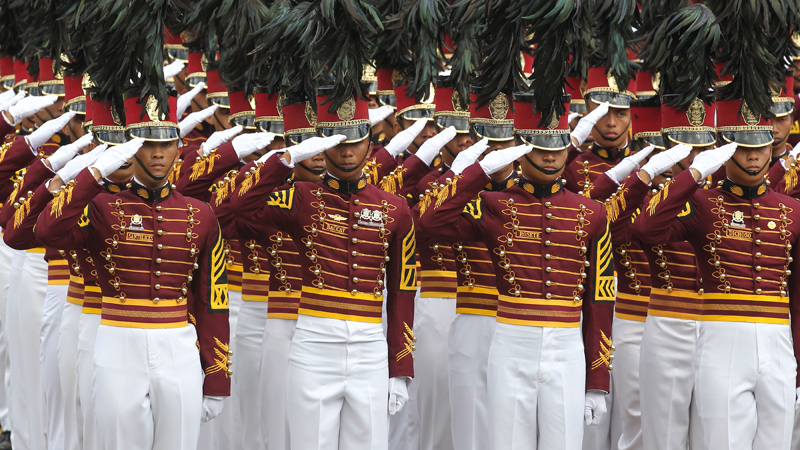
GUEST OF HONOR. President Aquino graces the 35th Philippine National Police Academy (PNPA) commencement exercises of the Class of 2014 at the PNPA Grandstand, Camp Gen. Mariano Castañeda in Silang town, Cavite province, on Monday. MALACAÑANG PHOTO BUREAU


MANILA, Philippines—The “fried chickens” have had enough of the “crispy patas” in the police service. 

Graduates of the Philippine National Police Academy (PNPA) are closing ranks to protest what they describe as the “inequitable” promotion among them and graduates of the Philippine Military Academy (PMA) in the 148,000-strong police force.

Rosendo Dial, PNPA Alumni Association Inc. chair, said Monday the group’s board of directors had approved a resolution seeking the help of Interior Secretary Mar Roxas in reviewing the current system of appointment of senior police officers to major positions in the Philippine National Police.

Roxas is an adopted member of PMA Class 1984.

Dial, the former chief of the Bureau of Jail Management and Penology, said the letter was a reiteration of a similar communication the association sent to PNP Director General Alan Purisima last year.

Equitable promotion

“What we are asking is for the national leadership [of the PNP] to implement an equal distribution of senior PNP officers from the PNPA and the PMA to key positions in the PNP,” Dial told the Inquirer on the sidelines of the 35th PNPA commencement exercises at Camp Gen. Mariano Castañeda in Silang town, Cavite province.

“We just hope that senior police officers who are products of the PNPA are also given the same chance afforded to PMA alumni who now head various units in the PNP,” he added.

He said the inequality in the promotion of senior police officers had led to the “demoralization” among some graduates of the PNPA.

“There’s a growing demoralization because they see that there’s no equal chance for them to land a good position in the PNP,” he said.

Dial, a member of PNPA Class 1986, noted that senior officers belonging to PNPA Class 1983 were designated to nominal positions in the police service while younger police officers from the military school in Baguio City were designated to critical offices in the PNP.

Although the present number of PNPA graduates in active service was almost 10 times more than the remaining PMA graduates, he lamented that products of the police academy had been bypassed in promotions in the PNP.

Star rank

At present, there are only three PNPA graduates—all belonging to PNPA Class 1983—with the rank of chief superintendent, a star-rank position equivalent to brigadier general in the military.

On the other hand, about 150 members of PMA classes 1981 to 1984 are holding the rank of chief superintendent or higher.

“If you look at the police organization, the PMA alumni are the minority in the PNP while the PNPA graduates belong to the majority. But in terms of position, PMAers hold the highest positions in the PNP,” Dial lamented.

“By the time they are promoted to chief superintendents, PNPA alumni are close to their retirement age already. So there’s no more time for them [to lead a PNP unit]. Their promotion is too late.”
In interviews with the Inquirer, several PNPA graduates expressed their discontent over the process of promotion and designation in the police service. 

Some of them admitted that they had been “forced” to seek the “blessing” of influential politicians, businessmen and even religious groups just to get major assignments in the PNP.

“For the past years, we have been expressing our displeasure regarding this discriminatory practice in the promotion of senior police officers through legal means. But our pleas fell on deaf ears,” said one of the griping PNP officials.

“The worst we can do is to have a sit-down protest. But if we do that, our careers would surely be put to waste,” he added.

Sources of leaders

Last year, the PNP Directorate for Human Resource and Doctrine Development formed a technical working group to study the reentry of PMA graduates into the PNP based on a proposal made by the PMA Alumni Association Inc. (PMAAAI).

The PNP defended its decision to consider the suggestion of the PMAAAI, with PNP spokesman Chief Supt. Reuben Theodore Sindac comparing graduates of the PNPA and the PMA to “fried chicken” and “crispy pata.”

“We should define the PMA as a leadership school [that] develops leaders. The PNP would like to avail itself of the leaders being produced by the PMA,” Sindac said.

Referring to the popular deep-fried pork leg dish, he said: “The PNPA is also a leadership school but maybe it might not be enough. We want to have a variety of [sources for officers]… so it will not be all just fried chicken. We will also have crispy pata.”

Sindac said the “education, formation and training at the PMA are different.”

Open letter

A group of unidentified PNPA graduates also sent an open letter to journalists covering Camp Crame.

In the five-page letter, the PNPA graduates expressed their concern over the unfair appointment of PMA and PNPA graduates in the PNP.

“With this gloomy prospect for PNPA graduates, even with their sheer superiority in numbers, they are coerced by the naked power of the minority to seek political patronage or even seek the endorsement of perceived religious heavyweights in order to be given a modest position in the PNP,” the group said.

“[The] counterpart of PNPA Class ’83, that is, the PMA ’83, is very fortunate to occupy eight key positions in the PNP and none for the four PNPA graduates,” it said.

“It is alarming to note, however, that eight key positions in the PNP are being occupied by PMA ’84 and none for the four PNPA Class ’83,” it added.

The group said Roxas, also the chair of the National Police Commission, “is perceived to ‘level the playing field’ and probably the only hope of non-PMAers to champion their ultimate dream” of being appointed to key posts in the PNP.

On the Nazis....

By Rod P. Kapunan

T
he Nazis are very much happy nowadays. They are happy because the Allies headed by the US and the present members of NATO thought they defeated the Nazis in World War II. Yes, they were defeated in that war, but the Nazis succeeded in converting the entire Western World into one big followers of their ideology.

The European Union (EU) and the North Atlantic Treaty Organization (NATO) is the 21th century version of the Axis Powers vigorously implementing the failed war plans of Hitler to dominate the whole of Europe and Africa. The big bangksters, the owners of the military-industrial complex, the oil cartel, the big industries and the pharmaceutical firms are united in promoting Nazism, except for the name of Hitler.

Every time they topple a legitimately elected President, they install a fascist or a neo-Nazi puppet, the latest of which is the puppet they installed in Ukraine. Nazism is now their official ideology because it is the devil ideology that will save their system from financial collapse. It is also a matter of time those stingy Jews who have become billionaires during the era of freewheeling capitalism will be arrested, placed in concentration camps and used as fuel to keep the engines of production moving.

The Zionists can only blame themselves for creating so much problems for capitalism which explains why many young and aggressive neo liberals are embracing Nazism as an ideology more than anything else. This explains why in his grave Hitler is now pointing a dirty finger at the Allies.

rpkapunan@gmail.com

Sulu sultanate warns of war

by Al Jacinto Correspondent


In 2013, Malaysian troops opened fire on the Sulu sultanate fighters that occupied a town in Sabah. Almost 60 of the fighters were killed in the clashes that lasted about a month. AFP PHOTO
ZAMBOANGA CITY: Members of the so-called Royal Security Force of the Sultanate of Sulu and North Borneo on Friday warned Manila that violence may erupt in southern Philippines if President Benigno Aquino 3rd fails to support their long-standing historical claim to the island of Sabah, now a state forming part of Malaysia.
In a statement sent to the regional newspaper Mindanao Examiner a day after the historic signing by the government and the Moro Islamic Liberation Front (MILF) of the Comprehensive Agreement on the Bangsamoro, a “General” Panglima, who identified himself as a leader of the security force, accused the Aquino administration of ignoring the claim by the sultanate to Sabah, whose historical name was Borneo.
“Nananawagan kami sa pamahalaan na sana po gawin nila o hanapan na lang ng paraan ang isyu na ito at huwag naman nila ito isantabi. One year na kami sa giyera at naghihintay mula nang sumiklab ang gulo sa Sabah noong February 2013 at 2014 na ngayon ay wala pa ring action ang pamahalaan ukol dito sa Sabah claim [We are calling on the government to not set aside this issue. We have been at war for one year and have been waiting for government action on our claim since violence erupted in Sabah in February 2013 and in 2014],” Panglima said.
He did not say how many men the Royal Security Force commands but are seen to number in the hundreds based on a deployment of fighters in early 2013.
In February last year, the ailing Sultan Jamalul Kiram III, of the Sultanate of Sulu, sent about 200 followers headed by his brother Raja Muda Agbimuddin Kiram to Sabah to assert their claim to and supposed historical rights over the state.
Sultan Jamalul’s group rejected Malaysian demand for them to surrender peacefully and fighting erupted in Lahad Datu town where more than 60 of the sultan’s men were killed and over 300 Filipinos arrested on suspicion that they were aiding the group of Raja Muda Agbimuddin.
Malaysia also put Sultan Jamalul and his brother on its wanted list and branded them as terrorists for intruding into Sabah and killing and decapitating 10 policemen and soldiers in separate clashes on the island.
Raja Muda Agbimuddin managed to escape the Malaysian assault in Sabah, while Sultan Jamalul died in October last year from a lingering illness at age 75.
Panglima in his statement said Manila failed or refused to help members of the sultanate and Filipinos who were said to be illegally detained in Sabah in connection with the fighting last year.
“The government ignored our claim. It still did not listen to us even after Sultan Jamalul died. The government wants to talk only about violence, which we are capable of creating throughout Mindanao, despite the government belittling our group, and so we call on the government to help us in our claim. Let us help each other and unite for all Filipinos, Christian and Muslim are brothers and are of one blood,” he added.
The Sultanate of Sulu and North Borneo continues to lay claim to Sabah. It obtained Sabah from Brunei as a gift for helping put down a rebellion on Borneo island. The British leased Sabah and transferred control over the territory to Malaysia after the end of World War II.
But the sultanate said it had merely leased North Borneo in 1878 to the British North Borneo Company for an annual payment of 5,000 Malayan dollars then, which was increased to 5,300 Malayan dollars in 1903.
The Sultanate of Sulu was founded in 1457 and is believed to exist as a sovereign nation for at least 442 years. It stretches from a part of the island of Mindanao in the east, to Sabah, in the west and south, and to Palawan, in the north. North Borneo was annexed by Malaysia in 1963 after a referendum organized by the Cobbold Commission in 1962 saw the people of Sabah voting overwhelmingly to join Malaysia.
Malaysia continued paying the sultanate 5,300 ringgits a year on the basis of the Sulu royals’ ceding the Borneo state.
It brokered peace negotiations between the government and the MILF that led to the signing of the peace agreement on Thursday.