Monday, December 7, 2009

MUST READ: Gloria Forever!

by Antonio C. Abaya
from Standard Today

The following paragraphs are from my column of Sept. 22, 2009 titled Festung Gloria:

There is no truth to the rumor that President Gloria Macapagal-Arroyo tells me in advance what she is going to do.

But I have a pretty good batting average when it comes to predicting what she will do.

After she promised on December 30, 2002, practically on the grave of Jose Rizal, that she would not run in the 2004 presidential elections, I wrote in my column of May 22, 2003 titled She Will Run, that she would. And she did.

Long before anyone thought of the possibility that President Gloria would use Charter Change to remain in power through a shift to the parliamentary system, I wrote in my column of May 17, 2005 titled Prime Minister Gloria? that she would. And she did.

In mid 2006, her then loyal ally, House Speaker Jose de Venecia launched two simultaneous operations to shift to parliamentary. One was a People’s Initiative, led by De Venecia factotum Raul Lambino and his Sigaw ng Bangaw to gather six million signatures endorsing a shift to parliamentary.

The other was a shameless attempt, led by JdV himself, to convene the Lower House into a constituent assembly, without the participation of the oppositionist Senate, to railroad a shift to parliamentary. Both attempts were shot down by the Supreme Court.

But how does President Gloria segue from president to prime minister? In my column of October 03, 2007, titled Dominatrix (referring to Gloria’s hold on the timid and mousy Romulo Neri), I wrote:

“A model (for GMA) may soon emerge in, of all places, Russia.

“Russian President Vladimir Putin was first elected in May 2000 from a field of ten candidates, with the support of the outgoing president, the late Boris Yeltsin. In March 2004, Putin was re-elected president with an astounding 71% of the votes. His presidential term ends in March 2008 and he is barred by the Russian Constitution from running for a third term.

“But – surprise! surprise! – he announced last Monday, Oct. 01, that he will run for a seat in the Russian parliament in the coming parliamentary elections on December 2, and that, as head of the ruling United Russia party, he had a `realistic’ chance of becoming prime minister……”

So as early as October 2007, I predicted that President Arroyo will follow the Putin Formula and run for a seat in Congress in May 2010 while she is still the sitting President.”

End of excerpts from my article Festung Gloria.

Now that President Arroyo has filed her certificate of candidacy for congresswoman of the second district of Pampanga, my predictions about her moves have come to pass with alarming – even to myself – accuracy.

Yes, there will be presidential elections in May 2010. No, she will not have her presidential term extended. But yes, she will run for – and win – a seat in Congress while she is the sitting president, like Vladimir Putin in Russia. But in practical terms how does she transit from president to prime minister?

There are two possible scenarios.

Scenario One. The elections in May 2010 will be the first ever computerized elections nationwide and there are just too many things that can go wrong. The more than 150,000 schoolteachers who will operate the system are totally unfamiliar with it. Many of them have never seen or operated a computer in their lives. Is there enough time to familiarize them with it? The system needs 80,000 technicians, one for each cluster of precincts. Do we have 80,000 computer technicians? The machines will not be ready until January 2010, at the earliest. Would there be enough time to train the 80,000 computer technicians in time for the May elections?

Many towns (and their voting precincts) do not have electricity or telephone connections. Even if the computerized counting machines were equipped with back-up batteries that will last supposedly for 18 hours, that may not be sufficient for remote communities that take hours to reach by foot, banca and/or carabao.

Keep in mind that there will be about 300 candidates’ names on the ballot. How long will it take each voter to go through such a long ballot? Is there enough time for 200 voters per precinct to go through 300 names, before the batteries go dead? This will not be like India where voters vote by party, and the parties’ easily recognizable symbols are what voters mark. Here voters choose individuals who most likely do not belong to the same party. Our electoral laws allow even our presidential and vice-presidential choices to come from different parties.

There are just too many things that can go wrong, or be made to go wrong, and likely will. That is Murphy’s Law, and it is in the Philippines, more than in any other country outside Black Africa and Haiti, where everything that can go wrong invariably does.

There is a strong possibility, therefore, that even if we do hold computerized elections in May 2010 and even if we assume good intentions on the part of the Comelec factotums and the schoolteachers, we would likely have chaos, real and/or manufactured, on May 10 that will result in a failure of elections.

This is especially true for the national offices at stake – president, vice-president, senator – because of the sheer volume of voters expected, 40+ million.. Even a ten percent failure rate would render the exercise a total failure that cannot be resolved by a back-up manual count because of the sheer number of voters and the geographical spread involved.

The situation is not so dire in the local offices at stake – congressman, governor, vice-governor, mayor, vice-mayor etc – in which a ten percent failure rate can be swiftly resolved by a back-up manual count, confined as it would be to small areas and their small local populations.

If because of even only a ten percent failure rate, there is no proclamation of a new president, a new vice-president, and 12 new senators by June 30, 2010, we will have no new government in place and we will have a constitutional crisis.

Section 7, Article VII of the Constitution says “Where no President and Vice-President shall have been chosen or shall have qualified, or where both shall have died or become permanently disabled, the President of the Senate or, in case of his inability, the Speaker of the House of Representatives shall act as President until a President or a Vice-President shall have been chosen and qualified.”.

In a failure of election scenario sketched above, there is no President or Vice-President proclaimed on June 30. There will also be no Senate President. The incumbent Senate President, Juan Ponce Enrile, is in office only up to June 30. He is running for re-election on May 10, but if there is failure of elections for national offices, no new Senate President will be chosen either because there will be no new Senate.

That leaves the Speaker of the House of Representatives as next in the line of succession, and I give you one guess as to who that Speaker is going to be. .

Scenario Two. If there is civil unrest and/or an insurrectionary situation before, during or immediately after the May 10 exercise, because of expectations of or the reality of failure of elections, then this would be a perfect justification for National Security Adviser Norberto Gonzales’ transition revolutionary government to kick in.

On at least two public occasions, Gonzales floated this scenario in which a revolutionary government, with the approval and participation of key sectors of society – the Churches, the military, civil society, the business community etc – would take over the reins of government, with the active presence and participation of Gloria Macapagal-Arroyo, and with the likely help of PMA Class of 1978, of which she is an honorary member.

Many Palace insiders, including Executive Secretary Eduardo Ertmita, feigned ignorance of and disdain for the Gonzales scenario. But the fact that President Arroyo appointed Gonzales acting defense secretary when Gilbert Teodoro resigned the post to run for the presidency, shows that Gloria implicitly approves of it. And why not?

Whether via Scenario One (constitutional) or Scenario Two (extra-constitutional), Gloria would remain in power beyond June 30, 2010. One of the first acts that House Speaker or Revolutionary President Gloria will predictably push will be to convene a constituent assembly (ConAss) – remember there will be no Senate in both scenarios – to shift to parliamentary so that she becomes Prime Minister, who holds that office as long as her party retains majority of seats in parliament.

In the Philippine context, that means she would likely be Prime Minister for Life. Gloria Forever!!! *****

OOOOOOOOOOOOOOOOOOOOOOOOOOOOOOOOOOO.

Reactions to tonyabaya@gmail.com or tony_abaya@yahoo.com.

Other articles in www.tapatt.net and in acabaya.blogspot.com.

Articles in www.tapatt.net may be forwarded to MySpace, Facebook, etc.

To view Tony Abaya on YouTube, go to www.tapatt.net, then scroll down.

To subscribe, click tonyabaya-subscribe@yahoogroups.com.

To unsubscribe, send a blank email with the subject heading Unsubscribe.

Follow me on twitter.com/tonyabaya.

Sunday, December 6, 2009

‘It’s like Rwanda’: UN expert on Maguindanao massacre

SOURCE: Ellen Tordesillas

by Romel Regalado Bagares

COTABATO CITY.–Peruvian forensic anthropologist Dr. Jose Pablo Baraybar didn’t like what he saw when he visited for the first time Sunday the massacre site in Barangay Salman, Ampatuan town.

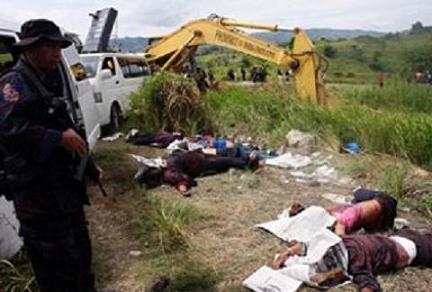
Take note of the backhoe with the marking 'Province of Maguindanao'

Take note of the backhoe with the marking 'Province of Maguindanao'

“It reminded me of something—it’s just like Rwanda,” said Dr. Baraybar after spending a few hours in the area in the company of Commission on Human Rights Chair Leila M. De Lima, British forensic investigator Chris Cobb Smith and lawyers from the Center for International Law (Centerlaw).

Baraybar said the “topography of the crime” in Ampatuan town is eerily similar to that he had found as a United Nations expert serving in the International Criminal Tribunal for Rwanda.

Barren hills, marked in places by an occasional clump of nipa huts, flanked a narrow dirt road that led to the scene of the carnage that claimed the lives of at least 57 people, including at least 29 journalists.

As he surveyed the area, Baraybar shook his head, remarking, “This is exactly the kind of topography that unfortunately provides an incentive for acts of impunity—its sheer remoteness keeps away public attention.”

In 1994, the genocide in Rwanda broke out and saw the systematic killing of some 800,000 Tutsis and moderate Hutus in less than 100 days by the Hutus. The East-Central African country, known as the “land of a thousand hills,” has an economy supported for the most part by subsistence agriculture.

The Peruvian expert and his British counterpart—both of whom also worked on the same cases for the International Criminal Tribunal for the former Yugoslavia—are doing a preliminary assessment of what still needs to be done at the crime scene, following the evidence-gathering already accomplished by police and National Bureau of Investigation investigators.

Baraybar heads a team of forensic investigators and lawyers deputized by the CHR to conduct an independent parallel investigation on the Ampatuan massacre. He also directed the Office on Missing Persons and Forensics of the UN Interim Administration Mission in Kosovo.

The group flew from Manila to Cotabato City and then travelled in a convoy of cars to the site. After an hour they reached the capital town of Shariff Aguak. When they passed through the palatial houses of the Ampatuans which were situated near the provincial capitol, they saw Ampatuan supporters with banners and screaming at the convoy “We love the Ampatuans!,” “Stop Blaming the Ampatuans,” among others.

From the capital town, it took them only seven minutes to reach the town of Ampatuan where the massacre happened. From the Ampatuan town center, the group reached the village of Salman in just three minutes. In the village is a detachment camp reportedly manned by paramilitary and police auxiliary militiamen when the killings happened. It was at the said detachment where the Mangundadatu convoy was stopped allegedly by policemen and militiamen on November 23, 2009.

From the detachment, the group of Dr. Baraybay turned right on a dirt road and after travelling for five kilometres through undulating hills planted to corn, banana, and papaya, they reached the site of the massacre.

There are at least three dug up holes in the site where bodies and crampled cars were uncovered. Papers, shoes, car interior parts, eyeglass case, and bullet shells are scattered around the massacre site. Despite the application of lime strewn all over the site, members of the team still smelled decaying corpse.

Baraybar and Smith declared the need to conduct further forensic examination in the area, especially considering reports that there are still unaccounted persons who may have been on the site when the Mangundadatu convoy was stopped by armed men.

When the group went back to Cotabato City, they met with two police inspectors who briefed them about how the retrieval of bodies and evidence was conducted a day after the killings happened. The police inspectors recounted the position of the corpses and the bloodied condition of the cars when they arrived in the scene of the killings.

Baraybar first came to the country to lecture in an international conference on the investigation and prosecution of extrajudicial killings, enforced disappearances and torture held in Davao last year under Centerlaw’s auspices.

(Romel Regalado Bagares is executive director of the Center for International Law, a member of the Southeast Asia Media Defense Network.)

Saturday, December 5, 2009

Maguindanao Massacre: Cause and Effect

Theres The Rub
by Conrado de Quiros
from Philippine Daily Inquirer

I do not just mean that in the sense that the massacre of 57 people in Maguindanao was an event everyone knew would happen. That it was just a matter of time, place, and scale of atrocity. I mean that in a larger sense. In the sense that there was something inevitable about it, given the signal, message, and example the national government had been sending all this time.

There are three of them. They bear directly on what happened in Maguindanao as cause does to effect.

The first is the theft of the vote in 2004. The coming to light of the “Hello, Garci” tape in particular, not least with its revelations of Virgilio Garcillano proposing the kidnapping of a public schoolteacher in Tawi-Tawi and President Gloria Macapagal-Arroyo assenting by silence, sent forth a powerful message. Henceforth, the vote meant nothing. Henceforth, keeping power meant everything. Henceforth, doing everything in one’s power to win power and keep power, including stealing, kidnapping, and where necessary, killing, is perfectly acceptable.

The Ampatuans’ participation in the theft of the vote moreover guaranteed them impunity. It wasn’t just Garci who had made Arroyo win in Muslim Mindanao, it was the Ampatuans too. That Fernando Poe Jr. got zero votes in a place he was worshipped as hero was either a statistical impossibility or the product of fear so absolute no one dared signify otherwise. Either way, it encouraged the Ampatuans to up the ante on terror and violence, the two things the Arroyo and US governments pass themselves off as fighting.

Going further, Arroyo defended herself from threats of unseating by force. Specifically by investing in Hermogenes Esperon and Norberto Gonzales, and by threatening martial law then and threatening martial law now. Arguably it’s institutional violence and not bloodcurdling violence, but it’s violence nonetheless. Arguably it’s nothing like the biblical or Koranic smiting of enemies, but it’s a modern-day, efficiency-oriented, facsimile of it nonetheless.

The second is the killings of political activists. Arguably too, that was done over a period of time and a lot more invisibly. If Arroyo’s hordes hadn’t gotten carried away and made Jonas Burgos disappear for good, they themselves might have disappeared in the thicket of anonymity and public apathy. But for all that, it is far more bloodcurdling in a deeper sense. The quantity alone suggests so—more than tenfold the number of the Ampatuans’ victims. As to the quality, well, ask yourself who’s the more monstrous, Attila who swept over the countryside raping and pillaging, or Hitler who sent six million Jews up in smoke perfectly clinically.

The wholesale murder of political activists upped the ante even more on what was permissible under the new order of things. Such was the ease with which this could be done—not least because of the apathy that had settled on the minds of the populace, not unlike the dread that had taken hold of the hearts of the Maguindanaoans—the perpetrators no longer bothered hiding their hand.

Philip Alston did point to Jovito Palparan as the immediate culprit, while noting that he was merely carrying out a policy of the state. The military was just as quick to point to the New People’s Army as Andal Ampatuan to point to the Moro Islamic Liberation Front (MILF) after being caught pretty much in the act. If you were the Ampatuans, why should you think Arroyo has any right to prevent you from massacring your enemies? At least, praise the Lord, or Allah, you’re fanatically honest, or honestly fanatical, about it.

If the Ampatuans hadn’t gotten carried away, little caring whether they butchered partisan or journalist, who knows? For all its heinousness—done deliberately to dissuade the stoutest of challengers—the atrocity might have drawn routine condemnation but slipped into the night as just another one of those nasty things that happen down there, wreaked by Muslim and Christian alike, by Abus and warlords alike.

The third is a culture that rewards deviltry and punishes decency, which is the culture that underlies the culture of impunity itself. Why should the Ampatuans fear retribution, or imagine that Arroyo, who would not be there except for them—and who would no longer be there if they confessed to that earlier crime—would not protect them in their hour of need? Everyone who has done nasty things for Arroyo has seen his station in life improve.

Palparan, who carried out the execution of political activists with a zeal over and beyond the call of bloodlust, was promoted to general and thence to (party-list) congressman. Esperon, who betrayed his comrades-in-withdrawal-of-support and who thenceforth vowed death and destruction to Arroyo’s enemies, has seen his star blaze beyond the normal sheen of the cluster of stars on a general’s shoulder. Mike Defensor, Lito Atienza, and Avelino Razon, who helped kidnap Jun Lozada and cover it up, have gotten a joint venture with a Chinese company to mine nickel, the Department of Environment and Natural Resources, and the post of Presidential Adviser on the Peace Process, respectively.

Arguably, the Ampatuans’ atrocity did not advance Arroyo’s cause, unlike the others’. And arguably what the Ampatuans did goes beyond “acceptable mayhem” even for an incontinently mayhem-filled place. But why shouldn’t they be allowed now and then to commit atrocity purely, simply and exclusively for themselves? Arroyo has. Why shouldn’t they be the epitome of warlordism, corrupting everything they touch, showing resolve of a scale, order and viciousness never known before, and plotting to rule forever by the threatened or real extinction of their enemies? Arroyo is.

Like I said, cause and effect.

Friday, December 4, 2009

Politically Incorrect Maguindanao

by Antonio C. Abaya
from Standard Today

Notice how politically correct CNN and the BBC were in their otherwise extensive reportage on the massacre in Maguindanao. Neither the BBC nor CNN mentioned the fact that Maguindanao is a predominantly Muslim province, or that the massacre was a direct result of the literally fight-to-the-death rivalry between an established Muslim political clan and a challenger Muslim political clan, both armed to the teeth.

As a result of the political correctness of CNN and the BBC, one can arguably conclude that millions of cable TV viewers worldwide have come to the conclusion that this kind of murderous politics is typical of the rest of the Philippines.

Only the other day, obviously worried about their safety, participants from Russia, Vietnam, Bhutan and Sri Lanka pulled out of an international mathematics competition to be held starting tomorrow in Iloilo City.

One can only guess how many thousands of tourists have cancelled holidays in Boracay or Baguio or Palawan, (or Iloilo City) not knowing that their destinations are a world away, in kilometers and political culture, from murderous Maguindanao.

And because at least 24 (or is it 30?) of the 64 known fatalities in this massacre were media persons – most of whom, from their names, were non-Muslims – our reputation as the most dangerous country in the world for journalists has just been engraved in stone for all posterity to remember.

I say, political correctness sucks.

An article by Ryan D. Rosauro in the November 29 issue of the Philippine Daily Inquirer – titled Why `rido’ persists in Maguindanao – tells it like it is.

“Clan feuding , more popularly known as `rido’ – which is blamed for the massacre –is a common occurrence in the social landscape of Maguindanao, where members of the Ampatuan clan virtually reign as political overlords.

“A study on the incidence of rido, done in 2005 by Abhoud Syed Lingga of the Institute for Bangsamoro Studies, found that all 28 towns (in Maguindanao) plus Cotabato City, were rocked by clan feuds…..

“Among the Maguindanaoan people, rido or `ukag’ is directly related to the concept of `kanaman,’ which pertains to a deep sense of personal dignity and honor, and self-respect.

“According to Professor Jamail Kamilan of the Mindanao State University, when this honor is violated , an aggrieved person avenges the psychological hurt to the extent of carrying out a killing – which in turn can invite retribution…..

“Political rivalry tops the major triggers of rido in Maguindanao, accounting for almost 20 percent of cases…In the Lingga study, the 218 clan feuds had resulted in 811 people dead and 369 others wounded….Clan conflicts infuse social discord; the enmity can last for generations that polarize residents in a community…..

“The Lingga study also asserts that rido `is a consequence of the absence of justice brought about by the inefficiency and ineffectiveness of the justice system….Weak governance in the region aggravates this problem. For one, parties in a rido have easy access to guns that underpin their bloody campaigns against each other.

“For another, the social environment is ripe for those well-connected with or part of established political authorities to carry out violence almost with impunity. It’s as if the violation of one’s honor constitutes a challenge to formal authority. Or a challenge to formal authority violates one’s honor.

“In communities such as Maguindanao, where political office is almost like a personal possession, it is not surprising why rivalry in the elections could trigger vendettas.***

End of excerpt from the article by Rosauro.

The Ampatuans are the lords and masters of Maguindanao province. An Ampatuan sits as governor of the province, with his brother-in-law as vice governor The suspected leader of the massacre, Andal Ampatuan Jr., is mayor of Datu Unsay town, where a brother is his vice mayor. Another Ampatuan is mayor of Sharif Aguak town, with another brother as his vice-mayor. An Ampatuan is also governor of the entire Autonomous Region of Muslim Mindanao (ARMM), of which Maguinadanao is a part.

In Datu Saudi Ampatuan town, an Ampatuan is also mayor, while a nephew is vice-mayor. In Mamasapano town, an Ampatuan is mayor, while his cousin is vice-mayor.
In Ampatuan town, grand nephews of Ampatuan Sr. are mayor and vice mayor. Etc etc. This is getting monotonous, but you get the picture.

By challenging the Ampatuans for governorship of Maguindanao, Esmael Mangudadatu, who lost his wife and four other kin in the massacre, was poking his finger into the eyes of the Ampatuans. Which is why his relatives were massacred, along with dozens of other people who had nothing to do with their clan rivalry.

The Ampatuans are political allies of President Arroyo. In the 2004 presidential elections, Pres. Arroyo won in most towns of Maguindanao. In one town, her rivals did not get a single vote.

In the `Hello Garci’ tapes, made public in July 2005, Maguindanao was one of four predominantly Muslim provinces about which someone who sounded like Pres. Arroyo was recorded talking to someone who sounded like Comelec commissioner Virgilio Garcillano, discussing her “one M” (presumed to mean one million votes) during the 2004 vote count, and the male voice promised her “Pipilitin po namin.”.(”We will try our best.”)

No wonder that the first reaction of President Arroyo’s spokeswoman, the servile Lorelei Fajardo, was: “I don’t think the President’s friendship with the Ampatuans will be severed. Just because they’re in this situation doesn’t mean we will turn our backs on them.”

Naturally. If the Ampatuans were to sing about 2004 and 2007, Gloria Arroyo’s goose would be cooked. With friends like the Ampatuans, who are in a position to blackmail her, Gloria does not need enemies.

In the 2007 senatorial elections, the administration’s candidates scored a 12-0 sweep in Maguindanao, with Luis `Chavit’ Singson from faraway northern Luzon improbably topping the vote count, although he was only no. 23 nationwide. (This recalls the 1995 senatorial elections in which Juan Ponce Enrile, also of faraway northern Luzon, also improbably topped the vote count then, way ahead of a local Muslim candidate, Tillah, whose first name I cannot recall).

Since the 1949 elections, when “the birds and the bees” and dead people started voting in Lanao – another predominantly Muslim province – the Muslim parts of Mindanao have been the favorite sellers’ market for votes. Vote counts in Muslim Mindanao are usually three weeks to three months delayed in tabulation. And for good practical reasons.

Candidates for national offices – president, vice-president, senator – calculate how many votes they need in order to win, after tallying the votes from the rest of the country. Once they determine their deficits – 200,000, 500,000, one million – their buyers go to Muslim Mindanao and buy the votes they need from vote wholesalers, like the Ampatuans.
.
In my article of June 28, 2007, titled Moro-moro in Maguindanao, I wrote about the inability of the Comelec to arrest a provincial electoral official, Lintang Bedol (remember him?), in charge of Maguindanao, who could not produce the election returns that would have substantiated the clean sweep of administration candidates in his province, on the grounds that the documents had been stolen from him in a hotel in Marawi City. His dog might also have eaten the documents. To date, he remains at large.

I also wrote that “to put a stop to the recurrent moro-moro (of Manila-based national politicians buying votes from vote wholesalers in Muslim Mindanao), we have to make drastic changes in the way we conduct elections for national offices. The most sensible idea is to hold these national elections in Muslim Mindanao ahead of the rest of the country. At least two weeks ahead, with all the safeguards and security measures at the command of a Comelec with more guts and nerve than the present one….”

“By holding national elections two weeks ahead of the rest of the country, the Muslim provinces would no longer be corrupted by national politicians based in Metro Manila as their repository of winning votes that they can buy from corrupt vote wholesalers, who are usually the provincial feudal overlords themselves (or their proxies).

“Liberal bleeding hearts, concerned with political correctness, will complain that this will reinforce feelings of separateness among our Muslim brothers and sisters. But again I say, To hell with political correctness. If explained adequately to them, especially to their imams, most Muslims, I think, can be convinced that holding separate national elections would be no more discriminatory than Muslims going to their mosques on Fridays and Christians going to their churches on Sundays. ” *****

OOOOOOOOOOOOOOOOOOOOOOOOOOOOOOOOOOOO

Reactions to tonyabaya@gmail.com or tony_abaya@yahoo.com.

Other articles in www.tapatt.net and in acabaya.blogspot.com.

Articles in www.tapatt.net may be forwarded to MySpace, Facebook, etc.

To view Tony Abaya on YouTube, go to www.tapatt.net, then scroll down.

To subscribe, click tonyabaya-subscribe@yahoogroups.com.

To unsubscribe, send a blank email with the subject heading Unsubscribe.

Follow me on twitter.com/tonyabaya.
Thursday, December 3, 2009

5 Arroyos in Congress may set a world record

Written by Carmela Fonbuena
TUESDAY, 01 DECEMBER 2009
If President Gloria Macapagal Arroyo wins as representative of the 2nd district of Pampanga in the May 2010 elections and 4 of her relatives also get elected to the House of Representatives, the Philippines may yet set a new world record on political dynasties.

"There will be 5 Arroyos in the House. I am not sure that's happened elsewhere. It's all in the family," said Nueva Ecija Rep. Edno Joson, who, on Monday, came out with a full-page newspaper advertisement calling for new blood in politics.

“I am not aware of any such similar situation abroad," noted lawyer Carlos Medina, referring to the number of family members occupying one law-making body.

"If it happens here, it will be an abomination,” noted Medina who is with poll watchdog group Legal Network for Truthful Elections.

Rep. Joson and Medina both assailed the President's congressional plans amid recent not-so-flattering news about the Philippines.

"Perhaps she wants to make it to the Ripley's Believe it or Not or the Guinness World Records as the first President to become the Speaker of the House of Representatives, as the longest serving public servant rated as No. 1 in corruption, and No. 1 in rice importation," Rep. Joson added.

Last November 23, the Philippines landed in the record books for having the most number ofjournalists killed in an election-related incident when 30 died in the Maguindanao massacre. The carnage was allegedly committed by a close ally of President Arroyo--the Ampatuans of Maguindanao.

"Kailangan ng bagong dugo na mamuno at magsilbi para magsimulang maka-ahon sa pagkasadlak sa dusa ang ating bayan. Sobra na! Tama na!--ang karahasan, kahirapan, at korapsyon na patuloy na dinaranas ng ating bayan na gawa ng mga naghaharing pamilya at angkan ng ating bansa mula sa pangulo hanggang sa ating mga barangay," Rep. Joson's ad said.

Speculations that President Arroyo would run for Congress were confirmed on Monday. Her election lawyer, Romulo Macalintal, said the president wants to continue serving the people and the nation as a member of the House of Representatives.

ALL IN THE FAMILY

Relatives occupying positions in various government posts are common even in democratic governments.

Sets of father and son, mother and son, and brothers serving at the same time are common in legislatures such as in India and Botswana. (Read story on Indian parliament here and Botswanahere)

Likewise, in the United States, relatives have served simultaneously in the House of Representatives.

But to have 4 family members—and possibly 5—in one law-making body all at the same time is rare.

There are 4 Arroyos in the current 14th Congress. They are

- presidential son Pampanga Rep. Juan Miguel “Mikey” Arroyo
- presidential son Camarines Sur 1st District Rep. Diosdado “Dato” Macapagal Arroyo
- President Arroyo’s brother-in-law Negros Occidental 5th District Rep. Ignacio “Iggy” Arroyo,
- President Arroyo's sister-in-law Ang Kasangga party-list Rep. Ma. Lourdes Arroyo.

President Arroyo plans to take over the post of son Mikey. But if rumors are true, Mikey will be joining a party-list group so he can possibly stay in the House of Representatives. Abs-cbnNEWS.com/Newsbreak sent the congressman a text message to verify the rumors, but he has yet to answer our query, as of this posting.

Rep. Iggy Arroyo is on his second term and is still eligible for another 3-year term.

Reps. Dato and Lourdes are on their first terms in the lower House.

Dato has filed his certificate of candidacy in the newly created district in Camarines Sur province. President Arroyo signed the law creating the new Camarines Sur district.

However, President Arroyo is not the first to run for a lower post after serving as Philippine president. Jose P. Laurel, president from 1943 to 1945 during the Japanese Occupation, served as a senator after the war.

SERVICE TO KABALENS

In a press statement on Monday, Mrs. Arroyo said she would still be the country’s President and would only allot a short period of time for her campaign.

“I will be firmly in control of our national government until the last day I am in office,” the president said.

"As president, my first commitment is to the nation we all love. My bid for Congress will be spirited but secondary to my duties as President,” she added.

“After much contemplation, I realize that I am not ready to step down completely from public service,” she said.

The president said the clamor of her province mates to run convinced her not to retire from politics.

“So after much soul searching, I have decided to respond affirmatively to their call...To that end, I will fill my candidacy for Congress in order to serve the hard working people of my home province,” she said.

The president is expected to make a formal announcement when she visits Lubao, Pampanga on Tuesday.

PROLONGING HER REIGN?

The militant group Bagong Alyansang Makabayan (Bayan) was quick to condemn President Arroyo's political plans.

"This is a dark day for the Philippines. Her running for Congress is a slap on the face of the many victims of her administration. Her running for Congress is proof that she wants to somehow prolong her reign of terror," warned Bayan secretary-general Renato Reyes Jr. on Monday.

"Her attempt to get a congressional seat is not borne out of a desire to serve but by a desire to get political leverage and avoid accountability for the many crimes committed by her regime," Reyes added.

If President Arroyo becomes the next House Speaker, as feared by her critics, she will have vast powers against the elected President. If elections were held last October, the next president will likely come from the ranks of the opposition.

However, Mrs. Arroyo will need to keep the current Lakas-Kampi-CMD congressmen—most of them reelectionists—in the party so that they will continue to be the majority in the next Congress.

CHARTER CHANGE IS NEXT?

Retired Archbishop Oscar Cruz, a critic of Mrs. Arroyo, suspects that Charter change is on top of President Arroyo's plans.

"There are 3 observations on GMA (President Arroyo) wanting to be in Congress: She manifests addiction to power. She exhibits lack of propriety. She remains fixated to have Charter change as soon as possible to target the Office of Prime Minister," he told abs-cbnNEWS.com/Newsbreak.

Since the 13th Congress, the House of Representatives has gone against public opinion by pursuing Charter change.

Three measures on Charter change are pending in the lower House--to convene a Constituent Assembly, to convene a Constitutional Convention, and a "fourth mode" which is to pass a legislation to scrap the nationalist restrictions in the 1987 Constitution.

The House of Representatives also has the exclusive authority to initiate an impeachment complaint against the President and other impeachable officials such as the Ombudsman.

It has the power of the purse. It can launch congressional inquiries. Members are immune from arrest while Congress is in session. It also has the power to declare state of war or state of emergency.

Through the Commission on Appointments (CA), senators and congressmen can approve or reject appointments made by the President. (abs-cbnNEWS.com/Newsbreak)

Wednesday, December 2, 2009

Another look at the massacre

ON DISTANT SHORE
by Val G. Abelgas

“What’s happening to our country?”

This rhetorical question was whispered by former Vice President Emmanuel Pelaez to Police Gen. Tomas Karingal in 1982 while he was being wheeled to the hospital after being shot by assassins after attending mass at Mt. Carmel Church in Quezon City during the dark days of the Marcos dictatorship.

The question has been asked many times since then in hundreds of articles about the major ills of Philippines society — corruption, injustice, violence and other social problems.

I will take the liberty to ask it again after the shocking and brutal massacre of 64 civilians, including 30 journalists, in Maguindanao last week. What is happening to our country? Why has our beloved country sunk so deep that an international forensics expert has compared the death scene as very much like those he had seen in Rwanda.

“This looks like Rwanda,” Peruvian forensics expert Jose Pablo Baraybar was quoted as having described the massacre site. Baraybar was referring to the tiny African nation where 800,000 Tutsis were killed by Hutu militiamen at the height of a civil war in 1994.

But Rwanda was at the height of a civil war then. The Philippines is supposed to be at peace, and the civilians were ambushed and cold-bloodedly gunned down while on their way to file a certificate of candidacy for a man who was so afraid to face his opponents he sent his wife, two sisters, supporters and journalists to be murdered by his political rivals and the more than 100 militiamen who were blindly following orders.

In addition to being compared to Rwanda, the Philippines has now overtaken war-torn Iraq as the most dangerous place in the entire world for journalists.

It’s disheartening that the news of the massacre came after the Philippines attracted international recognition for the resounding victory of boxing icon Manny Pacquiao over Miguel Cotto, establishing himself as the one of the world’s greatest boxer ever, and the crowning of Efren Penaflorida as the CNN Hero of the Year.

The massacre was so shocking and so frightening that a few days later, four countries – Russia, Vietnam, Bhutan and Sri Lanka — withdrew from an international math competition scheduled to start in Iloilo City last Monday, fearing safety for their contestants.

Tribal and clan wars are known to be a common occurrence in many parts of Mindanao, but the brazenness of the Maguindanao massacre makes one wonder why was it that the perpetrators didn’t seem worried about being caught, as if some powerful group assured them that they were going to be protected.

Was it just a feeling of invincibility, having been in control of the province for many years? Was it just a seething hatred for the Mangudadatus that led them to kill the wife, the sisters and the supporters? But why kill the journalists, too?

One writer, Erick San Juan, offered the possibility that the massacre was instigated by “foreign hand” that has long shown more than keen interest in Mindanao. San Juan said the massacre was part of a grandiose plan to Balkanize that mineral-rich region and eventually establish a friendly state that would enable them to establish a foothold in Southeast Asia. Balkanization is a term used to describe the fragmentation of a region or a country into smaller units to enable the perpetrator to “divide and rule.”

He cited the tribal wars of Yugoslavia, East Timor, Iraq, Nigeria and Afghanistan that were alleged to have been instigated by the foreign hand.

It is not easy to agree with San Juan’s assessment, knowing that clan and tribal wars have long been a problem in that part of Mindanao. But so were tribal wars in those areas that succumbed to Balkanization, destruction and eventually control by the foreign hand alluded to by San Juan, which evidently is the United States.

Is it a coincidence that the massacre happened in the region controlled by the Moro National Liberation Front thru the Ampatuans and that the Mangudadatus are said to be sympathizers of the Moro Islamic Liberation Front?

I have warned in previous articles of the unusual interest shown by the US in Mindanao, particularly in the Memorandum of Agreement on Ancestral Domain (MOA-AD) that delineated the areas in Mindanao that would be included in the proposed Bangsamoro state.

On August 4, 2008, in a column entitled “Bitter Pill to Swallow” about the possible US involvement in the rush to sign the controversial MOA-AD, I said:

“It is also possible the United States, in cahoots with the MILF, is pushing for the Bangsamoro Republic that would allow it to take a foothold on that region of Mindanao, which is not only very rich in natural and possibly oil resources, but is also a very strategic spot militarily.
“Certainly, there is an American card here somewhere. For one, it has been reported that the US State Department had tasked a group called the United States Institute of Peace (USIP) to undertake a project to help expedite a peace agreement between the Philippine government and the MILF from 2003 to 2007 that would support the establishment of an ancestral domain.

“The report said the US’s special interest in the GRP-MILF peace agreement is meant to prevent international terrorist groups from exploiting the conflict in the Philippines after the Sept. 11, 2001 terror attacks on the US. The late MILF chairman Salamat Hashim reportedly personally wrote US President George Bush in 2003 to help resolve the conflict between the government and the Moro people.

“The US support for the peace talks with the MILF came during the same period that the MILF, through Salamat, declared that they had renounced terrorism to attain their political ends.

“Secondly, US Ambassador Kinney has lately been too patronizing with the Mindanao people, visiting almost every month with various gifts and projects.”

Again last October 19, in a column entitled “Dancing the cha-cha with Washington,” I wrote:
“This time, the MILF wants direct involvement by the US in the peace process. While it could be ascertained from the events of last year prior to the aborted signing of the MOA that the US had an indirect, albeit influential hand in the formulation of that controversial MOA, now the MILF negotiators want the Americans to openly mediate in the negotiations.

“On Friday, US Deputy Ambassador Leslie Bassett led senior American officials in a two-hour meeting with Murad Ebrahim, the MILF leader, in Maguindanao’s Sultan Kudarat town. 


“Basset reportedly assured Ebrahim of US support to the peace process in Mindanao. The US Embassy, however, wouldn’t categorically confirm the report, saying that “Ms. Bassett met with various leaders and officials in Cotabato as part of a routine familiarization visit.


“The US needs a more established military presence than the current Visiting Forces Agreement allows, and which the Philippine Constitution prohibits. A cooperative Bangsamoro Republic or even just a Bangsamoro Juridical Entity, which can enter into international agreements, can provide the US an opportunity to set up military bases in Mindanao, from which it can reassert its military power over Southeast Asia and check terrorism in the region.

“At the same time, a subservient Bangsamoro Republic can give American companies unlimited access to the region’s natural and mineral resources.”

Could San Juan have been right in asserting that the plan to kill Mangudadatu’s relatives and supporters got out of control when the 30 journalists who had joined the group were also killed?

All of these could be mere coincidences, and that the massacre was just the result of a seething bad blood between the two clans. But the similarities to what happened to Yugoslavia, Iraq, East Timor, Afghanistan and now, Mindanao, are just too eerie to ignore.
Going back to Pelaez’s question: What’s happening to our country? Being Balkanized?

(valabelgas@aol.com)

Tuesday, December 1, 2009

Arroyo-Ampatuan Unholy Alliance

PerryScope
by Perry Diaz

The gruesome and barbaric massacre of at least 57 unarmed civilians, including 27 journalists, shocked the world and left people wondering if what happened was an ominous sign of things to come. The bloody carnage in Maguindanao could spark violence that could engulf the entire island of Mindanao into the bloodiest political and clan warfare never before seen in the history of the country. The whole situation could only be described as “extremely volatile” which could cause a total breakdown of law and order and throw the region into chaos and anarchy. Indeed, November 23, 2009, will long remain as a day of ignominy in the annals of Philippine politics.

The following day, President Gloria Macapagal Arroyo declared a state of emergency in the provinces of Maguindanao and Sultan Kudarat. Arroyo’s presidential assistant for Mindanao Jesus Dureza told the media that the scope of the state of emergency “will allow the government and military the authority to prevent lawlessness and further political violence.” However, he said that it did not include suspension of the “bill of rights” or writ of habeas corpus.

A few hours after the imposition of a state of emergency, Dureza went to the Ampatuan residence in Shariff Aguak to meet and confer with the Ampatuans. It was attended by the clan’s patriarch, Maguindanao Gov. Andal Ampatuan Sr., and his two sons, ARRM Gov. Zaldy Ampatuan and Datu Unsay town mayor Andal Ampatuan Jr. who was accused of leading the 100 armed men who slaughtered the 57 victims.

Criticized for his unusual visit with the Ampatuans, Dureza defensively said that he merely told the Ampatuans about the creation of the Crisis Management Committee and about the investigation. He also said that there was no discussion about the accusation against Andal Jr. But shouldn’t he instead have invited them to meet with him at the police station as normally would have been the case?

What Dureza did was akin to US President Obama sending his assistant to meet and confer with Mafia dons, after they have slaughtered their enemies, to inform them that the government was investigating them for their involvement in the massacre. Why the unusual “special treatment” accorded the Ampatuans?

Two days later, Andal Jr. surrendered to Dureza. He was flown to General Santos City where he was met by no less than Justice Secretary Agnes Devanadera. The meeting had the aura of a visiting dignitary with Devanadera shaking Andal Jr’s hand. He was then escorted by Dureza’s men without handcuffs. Criticized for not doing a “standard operating procedure” in handcuffing an arrested suspect of a crime, Dureza explained that the keys of the two handcuffs his men had were lost. If he thinks that anybody would believe that, he’s wrong. But that just shows that “lying” seems to be the government’s “standard operating procedure.”

The following day, two disturbing news articles were reported. The first article, “Palace says Arroyo won’t cut ties with Ampatuans,” was reported by Christian V. Esguerra and TJ Burgonia from the Philippine Daily. The report says: “President Gloria Macapagal-Arroyo is maintaining her ties with the powerful Ampatuans despite their expulsion from the ruling party and the filing of multiple murder charges against one of them in connection with the Nov. 23 massacre of at least 57 people in Maguindanao province.”

Arroyo’s spokesperson, Lorelei Fajardo, further said, “I don’t think the President’s friendship with the Ampatuans will be severed. Just because they’re in this situation doesn’t mean we will turn our backs on them.” Fajardo went as far to cast doubts that the Ampatuans were involved in the massacre when she told the media that “it doesn’t mean that they are no longer our friends, if ever they indeed committed the crime.”

When reminded by reporters of “how the Ampatuans helped ensure Ms Arroyo’s disputed victory over opposition standard-bearer Fernando Poe Jr. in 2004, and how they delivered an astonishing 12-0 sweep in Maguindanao for the administration’s senatorial ticket in 2007,” Fajardo said that Arroyo’s role as President should be viewed as “separate” from her function as a political ally of the clan. In my opinion, the presidency is a political job and the president’s actions are always influenced by political considerations. They are intertwined like a Gordian Knot.

The second article, “Ampatuans won’t cut ties with Arroyo,” was reported by ABS-CBN. The report says: “In an interview with ABS-CBN, Autonomous Region in Muslim Mindanao Gov. Zaldy Ampatuan said he was very hurt by the arrest of his brother, Datu Unsay Mayor Andal Ampatuan Jr., for allegedly masterminding the massacre last Monday.”

Ampatuan said that he also was offended by the statements of Lakas-Kampi CMD standard bearer Gilbert Teodoro and the decision of the Lakas-Kampi leadership to expel the Ampatuans from the party. “They didn’t even consult us. They just expelled us from the party without asking any questions,” he said.

And in a naked display of power — and arrogance — he said that “despite the expulsion, his family remains a staunch supporter of the Arroyo administration” and that he is set to “meet with President Arroyo to discuss problems faced by several Lakas-Kampi candidates in Sulu.”

Evidently, notwithstanding the magnitude of the horrendous massacre of which members of the Ampatuan clan were suspected of having perpetrated, President Arroyo didn’t distance herself from the Ampatuans. Instead, she further reinforced their strong friendship and alliance. The gory spectacle of 57 brutally slaughtered civilians — many of whom were raped, beheaded, and mutilated — would have caused Arroyo to flinch and immediately sever her personal and political relationships with the Ampatuans. That would have been the right thing to do for a president of a country. Instead, she sent a subtle but clear signal that her alliance with the Ampatuans remains strong… and perhaps, stronger.

But why didn’t she divorce herself from her alliance — or is it “unholy alliance”? — from the powerful Ampatuan clan? Is she scared that if she abandoned them, they would retaliate by unraveling the “secrets” of how they helped her win in Maguindanao in 2004 and deliver a 12-0 sweep of her senatorial candidates in 2007? That would certainly open a can of worms and could cause a political storm that would destroy her politically and further tarnish her checkered image beyond redemption.

And since she is running for a congressional seat — unopposed — representing Pampanga’s second district, Arroyo needs the Ampatuans when she vies for the Speakership of the House of Representatives next year. And if she succeeded in changing the form of government to a parliamentary system, she would be in a position to become the Prime Minister. That would truly be a Machiavellian feat.

At the end of the day, for as long as Arroyo continues to pursue her dream of reigning for years to come, she would not let her political allies down, come hell or high water.

(PerryDiaz@gmail.com)